
The Unveiling of Canadian History - Volume 2
FORLORN HOPE
Quebec and Nova Scotia, and the War for Independence, 1775 – 1785
Part 8 – 1782, the Road to Independence
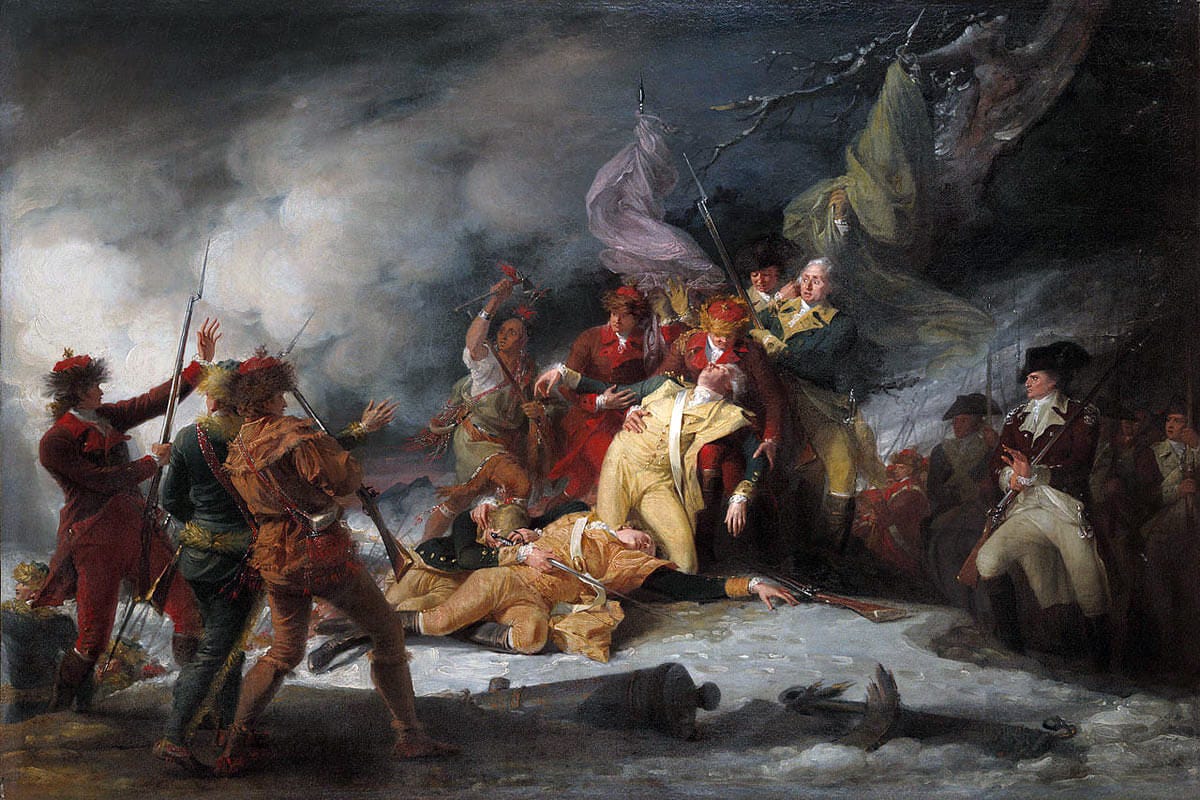
‘The Death of General Montgomery in the Attack on Quebec’, by John Trumbull (1786)
Chapter 55 - The Plan of Campaign, May 1st 1782
After spending the winter in Philadelphia with Congress, at the end of March 1782 General Washington left Philadelphia to return north and rejoin the Army. On April 12th, he wrote to Benjamin Lincoln:
“the Nature of our Operations… must depend greatly on the Views of the Enemy and the particular Mode of War which they shall in future adopt. Whether an Evacuation of Charlestown will take place or not, or whether the Enemy will cease their Efforts in whole or in part in the southern Quarter, I am unable to decide… From the above observations you will perceive the State of Uncertainty in which I am placed.”
But also on April 12th, during the Battle of the Saintes, De Grasse and his French fleet of 35 ships fought a sea battle with a British fleet of 36 ships under Rodney, during which De Grasse’s ship was forced to surrender and De Grasse was taken prisoner. When the news reached Canada on June 10th, the houses of the British were lit and their sailors threw stones and broke the windows of any Canadian house that was not.
At Newburgh, General Washington wrote up his ‘Plan for the Campaign’ (dated May 1st 1782) in the order of his estimate of their importance: first, the reduction of New York, second, the reduction of Charleston and Savannah, and third, the annexation of Canada and Nova Scotia – all of which would depend upon the determinations of the Court of France and on the possession of a superior naval force.
Concerning Canada, he wrote:
“The Annexation of so Capitol a Province as this (Canada) to the Federal Union, the consequent subduction of all the Northern and Western Indians, and the restoration of Peace and quietness to such an extensive Frontier as we have from the River St. John’s, in the Bay of Fundy, to the Holstein in No. Carolina, are matters of great moment, and worthy of the most serious attention…
Beside these, an expedition into Canada would at once develop the mysterious conduct of the people of Vermont; bring them to an explanation in a manner of all others the most advantageous to us…
I shall say nothing of the benefits which America would derive, and the injury Great Britain must sustain, by the Fur and other trade of Canada shifting hands. Nor of the immense importance it must be to the future peace and quiet of these states, especially the western parts of them, to annihilate the British Interest in that country; thereby putting a stop to their intriguing after Peace shall be established.”
General Washington’s prescience of Britain’s use of Canada for their post-war policy toward the United States will be seen in the decades to come, as Britain refused to surrender her outer posts at Oswegatchie, Carleton Island, Niagara, Detroit and Mackinac – posts that would become part of the territory of the United States with the signing of the Definitive Peace Treaty in 1783 – and used these posts to continue British control of the fur trade and manipulation of the western Indian tribes, in an attempt to stop the settlement of the Ohio country by the Americans. Britain would not relinquish these posts until after the signing of Jay’s Treaty in 1796, and the further continuation of this policy would, in part, lead into the War of 1812.
On May 6th, Guy Carleton arrived at New York, as the new British commander-in-chief of the land forces, along with Admiral Robert Digby, as the new British commander-in-chief of the naval forces, with his instructions of April 4th from the new British government under Rockingham, for ‘withdrawing of the garrison, artillery, provisions, stores of all kinds and every species of public property from New York and its dependencies to Halifax’, and also the garrisons at Charleston, Savannah, and St. Augustine – as he saw fit.
The next day Carleton wrote to General Washington and enclosed copies of the proceedings of the House of Commons of March 4th respecting an address to the King in favour of peace, and of a draft bill enabling his Majesty to conclude a peace or truce with the colonies. Carleton also requested a passport for Maurice Morgann, the private secretary of Shelburne, to travel to Philadelphia, but Congress refused – since the advances of Carleton bore so strong a similarity to those of the commissioners in 1778, which proved delusive and fruitless, that Congress deemed it advisable not to open any door for an intercourse through this channel, more especially as the business of negotiating a peace was entrusted to its commissioners in Europe.
On May 8th, General Washington wrote to Meshech Weare, President of New Hampshire, that:
“upon the most mature deliberation I can bestow, I am obliged to declare it as my candid opinion, that the measures of the enemy in all their views, so far as they respect America, are merely delusory… they are meant to amuse this country with a false idea of peace, to draw us off from our connexion with France, and to lull us into a state of security and inactivity, which having taken place, the ministry will be left to prosecute the war in other parts of the world with greater vigor and effect”.
On July 1st 1782, Rochambeau’s French army began to leave their camps in Virginia to start their march north, reaching Maryland on July 19th and resting at Baltimore for a month. On July 15th, General Washington returned to Philadelphia so that he could meet there with Rochambeau and discuss strategy. Rochambeau’s army was to conduct a slow, deliberate march north – designed to force the British into consolidating their forces in New York, instead of raiding any other American ports. They reached Delaware on August 29th, Pennsylvania on August 30th, New Jersey on September 2nd, New York on September 13th, where they crossed the Hudson river at King’s Ferry to Verplanck’s Point, joined with the American army and rested at Yorktown Heights for a month; reached Connecticut on October 23rd, Rhode Island on November 9th, and rested at Providence for 3 weeks; and finally reached Massachusetts on December 1st to embark on transport ships with Vaudreuil’s fleet in Boston harbour. On December 23rd Rochambeau and his French troops left Boston to travel on a mission to the West Indies.
On July 11th 1782, Carleton evacuated the garrison at Savannah to Charleston, and about 2000 tories with about 5000 slaves (and also including a small group of free blacks) left Savannah. When Carleton cancelled the evacuation of St. Augustine, East Florida became the first choice for the southern tory refugees, and the majority of tories travelled on a convoy to St. Augustine and another convoy sailed to Jamaica. (Many of the tory refugees would end up moving again and again.)
On July 31st, after receiving the June 5th ‘secret instructions’ from Shelburne, Carleton again wrote to General Washington on August 2nd, that:
“We are acquainted, Sir, by authority, that negotiations for a general peace have already commenced at Paris, and that Mr. Grenville is invested with full powers to treat with all parties at war, and is now at Paris in the execution of his commission… that his Majesty, in order to remove all obstacles to that peace, which he so ardently wishes to restore, has commanded his ministers to direct Mr. Grenville, that the independency of the thirteen Provinces should be proposed by him in the first instance, instead of making it a condition of a general treaty”.
On August 14th, Carleton offered Shelburne his resignation – but it wasn’t accepted until January 1st 1783, and he didn’t leave until the final evacuation.
On August 6th General Washington wrote to Greene, that:
“from the former infatuation, duplicity and perverse system of British policy, I confess I am induced to doubt everything, to suspect everything… whatever the real intention of the enemy may be, I think the strictest attention and exertion, which have ever been practised on our part, instead of being diminished, out to be increased thereby.”
He also wrote that:
“Indeed, I hardly know what to think or believe of the disposition of the court of Britain” - in part because he had also seen a New York paper - “in which is a speech of General Conway, and some other articles, which appear to be designed to propose independence to America on certain conditions not admissible, namely, that the legislature of America should be totally independent of the Parliament of Great Britain, but that the King of England should have the same kind of supremacy here as in Ireland”!!!
Regarding this ‘false independence’ (as in Ireland):
Earlier, at the beginning of the war, the Irish parliament had agreed to send 4000 Irish troops for military service in America, but refused to allow Hessian mercenaries to be sent to Ireland to replace them. In 1778, Catholics in Ireland were allowed to join the army but were not allowed to vote or hold office. In 1779, ‘Volunteer’ militias were formed by the Irish people for their own self-defence. As the economy of Ireland was deteriorating in order to feed the British army and to fight the war, non-importation agreements began to be organized in the Irish towns to encourage buying Irish made goods. In December 1780, the Earl of Carlisle was appointed the new Lord Lieutenant of Ireland, with Mr. Eden as secretary – the same Carlisle and Eden who had been sent to America in June 1778 as peace commissioners, whose proposals were rejected by Congress because they refused to acknowledge America’s independence.
On February 15th 1782, at a convention of 243 delegates from 143 Volunteer corps of Ulster province, 13 resolutions were passed – one of which was that Poyning’s Law was unconstitutional and should be repealed. (Since 1494, by Poyning’s Law, the Irish parliament was not allowed to initiate legislation – only the British parliament had that right.) The resolutions were adopted by all the Volunteer corps of Ireland. On April 16th, Henry Grattan introduced an amendment of demands of the Irish people – the Volunteer resolutions – which was passed by the Irish parliament. On May 17th, a resolution introduced in the British House of Lords by Shelburne and in the British House of Commons by Charles Fox, was passed whereby the British parliament gave up its authority over the Irish parliament, but whose laws were still subject to approval by the King’s Privy Council!!!
This was the ‘false independence’ that was rejected by Congress, but was now to be given to Ireland, and later to be given to Canada.
In October 1782, the evacuation from Charleston began of over 4000 tories with almost 6000 slaves, and of 1500 free blacks, again with most going to St. Augustine in East Florida, and others going to Jamaica and Britain, while 500 went to Halifax in Nova Scotia. On December 12th the garrison at Charleston sailed to New York.
[next week - chapter 56 - The Arrival of John Jay at Paris, June 23rd 1782]
*************
For those who may wish to support my continuing work on ‘The Unveiling of Canadian History’, you may purchase my books, that are available as PDFs and Paperback (on Amazon)
Volume 2 – Forlorn Hope – Quebec and Nova Scotia, and the War for Independence, 1775 – 1785.
Volume 3 – The Storming of Hell – the War for the Territory Northwest of Ohio, 1786 – 1796.
And hopefully,
Volume 5 – On the Trail of the Treasonous, 1804 – 1807.
may also appear in print, in the near future, while I continue to work on :
Volume 6 - Through the Perilous Fight, 1807 – 1814.