
The Unveiling of Canadian History - Volume 2
FORLORN HOPE
Quebec and Nova Scotia, and the War for Independence, 1775 – 1785
Part 7 - 1781, the Road to Yorktown
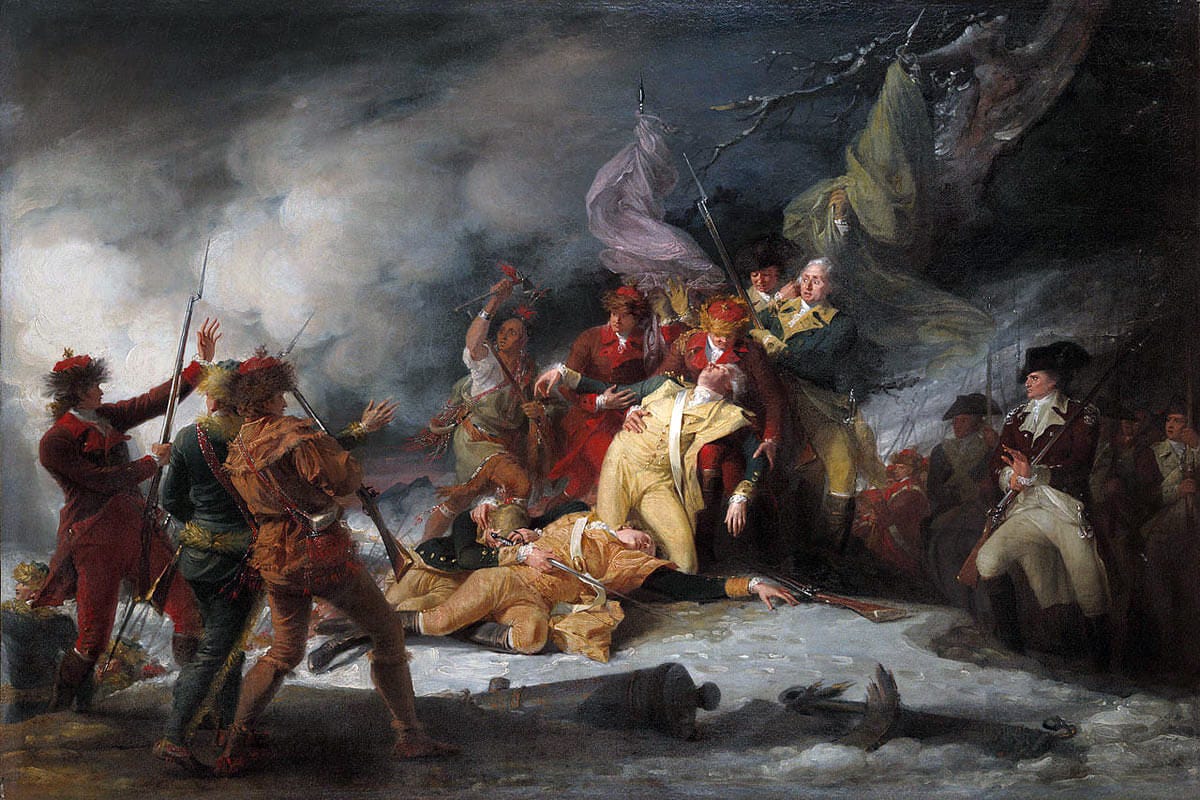
‘The Death of General Montgomery in the Attack on Quebec’, by John Trumbull (1786)
Chapter 52 - The War on the Western Frontier in 1781
At the end of 1780, George Clark had returned to Virginia to seek the approval of Governor Thomas Jefferson for an expedition against Fort Detroit. Jefferson wrote to Clark on December 25th:
“A powerful army forming by our enemies in the south renders it necessary for us to reserve as much of our militia as possible free to act in that quarter. At the same time we have reason to believe that a very extensive combination of British and Indian savages is preparing to invest our western frontier. To prevent the cruel murders and devastations which attend the latter species of war and at the same time to prevent its producing a powerful diversion of our force from the southern quarter in which they mean to make their principal effort and where alone success can be decisive of their ultimate object, it becomes necessary that we aim the first stroke in the western country and throw the enemy under the embarrassments of a defensive war rather than labour under them ourselves. We have therefore determined that an expedition shall be undertaken under your command in a very early season of the approaching year into the hostile country beyond the Ohio, the principal object of which is to be the reduction of the British post at Detroit”.
Jefferson proceeded to outline his plan for the attack. Jefferson also wrote to General Washington concerning this proposal and asked for his assistance in supplying the expedition with some artillery and stores at Fort Pitt.
General Washington replied on December 28th 1780:
“I have ever been of the opinion that the reduction of the post of Detroit would be the only certain means of giving peace and security to the whole of the Western frontier, and I have constantly kept my Eye upon that object; but such has been the reduced state of our Continental Force, and such the low ebb of our Funds, more especially of late, that I have never had it in my power to make the attempt. I shall think it a most happy circumstance, should your State, with the aid of Continental Stores which you require, be able to accomplish it. I am so well convinced of the general public utility with which the expedition, if successful, will be attended, that I do not hesitate a moment in giving directions to the Commandant at Fort Pitt, to deliver to Col. Clarke the Articles which you request, or so many of them as he may be able to furnish. I have also directed him to form such a detachment of Continental troops, as he can safely spare, and put them under the command of Col. Clarke.”
On January 22nd, Governor Jefferson appointed Clark a ‘brigadier-general of all the forces to be embodied in an expedition westward of the Ohio’. Clark had been engaged under Steuben, in carrying on a defensive movement against the raid on Richmond by Benedict Arnold. Clark now left to return to the Ohio and to prepare to assemble the 2000-man force that was needed, hoping to be ready to leave by June.
In February, a council of the Delaware Indians at Coshocton decided, in violation of the alliance that they had made with the Americans, to go over to the side of the British, and war parties were organized to attack the frontier settlements. Colonel Brodhead, commander at Fort Pitt, decided to strike first and attack the Delaware town of Coshocton on the Tuscarawas river. Leaving Fort Pitt on April 7th with about 150 Continental troops, Brodhead proceeded to Fort Henry and was joined by 4 militia companies of 134 men. But the Delawares were warned of his advance and when Brodhead and his troops entered the town, they only found 15 warriors, who were killed in the attack. After taking great quantities of peltry and other stores, the troops set fire to the town, destroyed 40 head of cattle, and then returned to Fort Henry by May 1st.
On May 7th, Brodhead had to leave Fort Pitt and travel to Philadelphia – a subordinate had charged him with misfeasance and mishandling of supplies and money(15).
On May 21st, Colonel Crocket and 100 Virginia State troops arrived at Fort Pitt to join Clark. Clark had expected to have Colonel Gibson’s regiment of 200 Continentals, but with concerns of retaliatory raids by the Delaware and Wyandot Indians, Brodhead felt that Fort Pitt could not be defended if Gibson’s infantry were sent, but Clark would have Captain Isaac Craig’s artillery company – that General Washington had agreed to send. Clark had also been expecting over 700 militia-men from the Virginia counties of Hampshire, Berkeley and Frederick, but only a small number of volunteers would join him. Because these counties were exposed to the daily inroads of the Indians and because of the immense distance the men would have to travel from there to the Falls of the Ohio, and since men were already being sent for the Southern Army and the number of men that Clark was requesting made up half of the total county militia that were fit for duty, the counties were prevented from drafting any men for the expedition.
Clark now tried to organize volunteers from the Pennsylvania counties of Washington and Westmoreland to join the expedition, against the opposition of those who wished to keep the militia at home for defence from the British and Indian raids. With the approval of Joseph Reed, the President of the Supreme Executive Council of Pennsylvania, Colonel Archibald Lochry was able to recruit 100 volunteers from Westmoreland county and they marched to join Clark’s army at Fort Henry (Wheeling). After further delays in receiving the needed supplies and ammunition, Clark had finally left down the Ohio river from Fort Pitt with 400 men and arrived at Fort Henry by August 4th, and not wanting to delay any longer, left there on August 7th. But Lochry arrived at Fort Henry on August 8th, a day after Clark had left, and after building seven boats to transport the troops, on August 13th Lochry’s troops now travelled down the Ohio river, to try to catch up with Clark and to join them at Fort Nelson (Louisville).
In April, Joseph Brant with some Indian warriors had been sent from Niagara to Detroit, where they attended a grand council of the Ohio and Lake Indians held by DePeyster on April 26th. DePeyster promised to send supplies and ammunition to the Indians if they would rendezvous their warriors at the upper Sandusky villages and set out for the Ohio river to attack and defeat Clark’s army. While Alexander McKee was assembling the Indian army, Joseph Brant and George Girty with about 100 warriors, left Wapatomika to travel down the Miami river and were camped near its junction with the Ohio river, when Clark and his men passed by on August 18th, but Brant didn’t attack because of Clark’s superior force.
On August 24th, when Lochry and his men were passing down the river and came ashore to feed their horses, they were ambushed by Brant and the Indians. While 37 of Lochry’s men were killed, scalped and then thrown into the river – to send a message downriver to Clark’s army, the other 64 men were taken prisoner. While being held as a prisoner, Colonel Lochry was killed. A few days later, Brant was joined by McKee, Simon Girty and 400 Shawnee and Wyandot warriors and 100 Rangers. The combined force then set off in pursuit of Clark’s army, but Clark and his men arrived safely at Fort Nelson. Brant and McKee then returned to Detroit with their plunder and prisoners.
On September 5th Clark addressed a meeting of the Kentucky county commissioners”
“Gentlemen – For a series of years past I have made it my study to support and protect the back Settlements of our States, not from any particular Attachment I had to them, but knowing the very great advantage they were of to the Whole Continent as a Barrier against the Indians more valuable than is Generally Considered by the Continent at Large… and have proved of great importance by engaging the attention of the Enemy that otherwise would have spread Slaughter and Devastation through out the more Interior Frontier, deprived them of giving any assistance to our Eastern Armies, and more than probable, the Allegany would have been our boundary at this time.”
But with the news of Lochry’s defeat and of the abandonment of Fort Jefferson, and due to the shortage of men and the lateness of the season, it was the opinion of the Board that ‘under our present circumstances, it is impracticable to carry on the expedition’.
DePeyster had also sent Matthew Elliott and 250 Wyandots to the Delaware settlements along the Tuscarawas river to expel the Moravian missionaries who were suspected of passing intelligence on the Indians’ activities to the Americans at Fort Pitt. On September 3rd, the missionaries were seized and, along with 400 Christian Delaware Indians, were forced to relocate to ‘Captive’s Town’, a cluster of huts near the Wyandot villages on the upper Sandusky river.
Although the expedition against Detroit was not going to occur, the Americans still held a tenuous grip on the Illinois and Ohio countries. The British, however, aimed to keep their control over the Indian tribes on the frontier and send out destructive raids against the American settlements, and were able to maintain their outer posts with 1400 total troops – 100 regulars and 200 Royal Yorkers at Fort Haldimand on Carleton island, 250 regulars and 350 rangers (along with 150 Indian Department agents) at Fort Niagara and Fort Erie, 400 regulars at Fort Lernoult on the Detroit river, and 100 regulars at Fort Mackinac. (Fearing that Fort Michilimackinac was open to attack from the Americans, in November 1780 Commander Sinclair had moved with his troops to a new fort that was built on nearby Mackinac island.) And the 350-man navy department manned the small but growing number of ships on the great lakes between Carleton island and Mackinac island.
Footnotes for chapter 52:
(15) Brodhead would face a court-martial in February 1782, and was acquitted on all 8 charges. He later returned to the Continental Army, where he was made a brevet Brigadier General.
[next week - chapter 53 - The War on the Northern Frontier in 1781]
*************
For those who may wish to support my continuing work on ‘The Unveiling of Canadian History’, you may purchase my books, that are available as PDFs and Paperback (on Amazon)
Volume 2 – Forlorn Hope – Quebec and Nova Scotia, and the War for Independence, 1775 – 1785.
Volume 3 – The Storming of Hell – the War for the Territory Northwest of Ohio, 1786 – 1796.
And hopefully,
Volume 5 – On the Trail of the Treasonous, 1804 – 1807.
may also appear in print, in the near future, while I continue to work on :
Volume 6 - Through the Perilous Fight, 1807 – 1814.