
The Unveiling of Canadian History - Volume 2
FORLORN HOPE
Quebec and Nova Scotia, and the War for Independence, 1775 – 1785
Part 7 - 1781, the Road to Yorktown
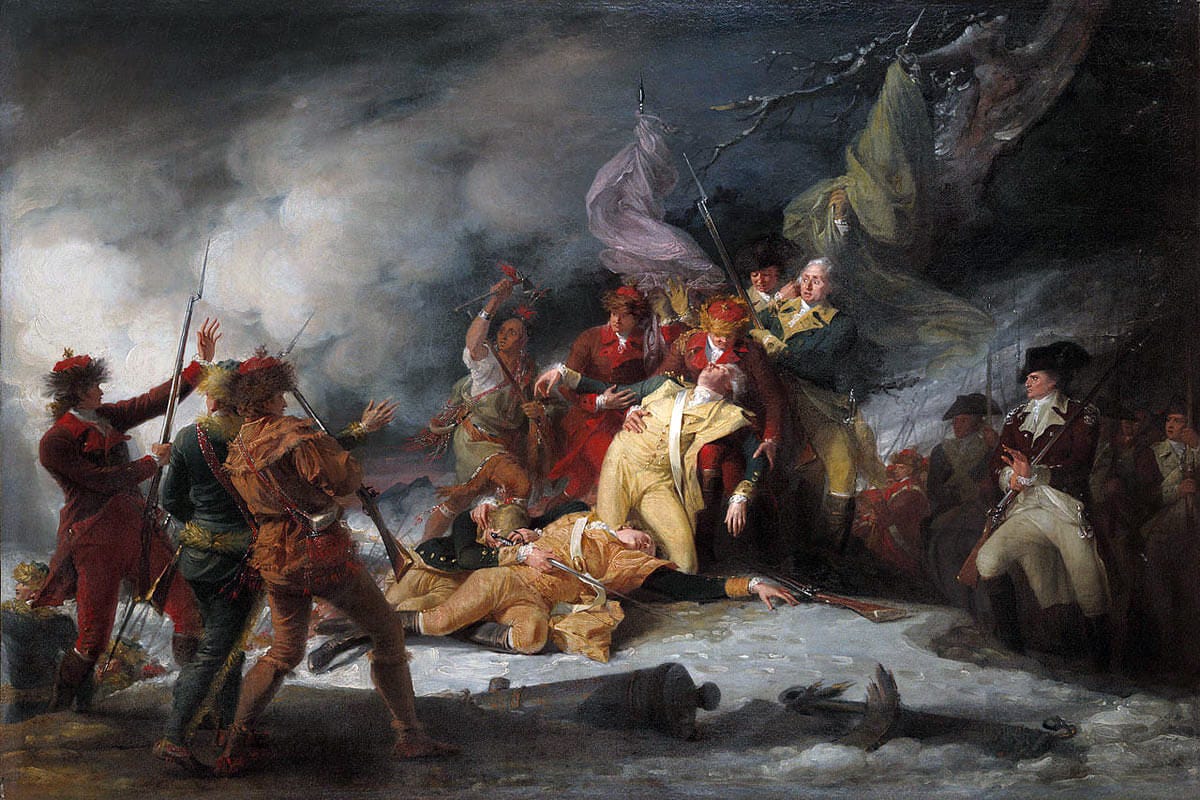
‘The Death of General Montgomery in the Attack on Quebec’, by John Trumbull (1786)
Chapter 49 - The Decision of General Washington, August 14th 1781
With Rochambeau and the French troops now having arrived in Connecticut, General Washington planned a joint French and American operation – to surprise the British works at the north end of York island, and also to attack Delancey’s rangers that scoured the fertile valleys in Westchester county and swept off forage and cattle for the British army at New York.
On July 2nd Lincoln left Peekskill with 800 men and moved down the Tappan Sea and crossed over to Fort Lee, to reconnoitre Fort Washington from the cliffs on the opposite side of the Hudson river. Lincoln discovered a British force encamped at the north end of the island with a ship-of-war anchored there in the river. Lincoln now abandoned any attempt at surprising the British works. On July 3rd Lincoln landed his troops above Spyt den Duivel creek and took possession of the high ground north of the Harlem river, where Fort Independence once stood. Here he was discovered by a strong 1500-man British foraging party and a skirmish ensued. The firing was heard by De Lauzun, who had just arrived at East Chester with his French troops, and finding the country now alarmed and all hope of surprising Delancey’s corps at an end, Lauzun hastened to Lincoln’s aid. Meanwhile General Washington, who had marched with his main army from West Point to Valentine’s Hill (4 miles above King’s Bridge), now advanced with his troops. Perceiving their danger, the British retreated to their boats and crossed over to York island.
On July 6th, General Washington marched his army back to Dobbs Ferry, where he was joined by Rochambeau and the French troops, and where they remained encamped for the next four weeks, while conducting a grand reconnaissance of the British posts on York island. During this time, the British garrison at New York was augmented by the arrival of three thousand more Hessian troops from Europe.
While General Washington waited at Dobbs Ferry, his army was being tardily and scantily recruited. On August 2nd he wrote a letter to the governments of New Hampshire, Massachusetts, Connecticut and New Jersey, that:
[he was] “unable to advance with prudence beyond my present position… Our allies, with whom a junction has been formed upwards of three weeks, and who were made to expect, from the engagements which I entered into with them at Weathersfield in May last, a very considerable augmentation of our force by this time, instead of seeing a prospect of advancing, must conjecture, upon good grounds, that the Campaign will waste fruitlessly away”.
General Washington then received letters from Lafayette, who on July 30th had written that:
‘there are in Hampton-road thirty transport ships full of troops, most of them red coats… there are eight or ten brigs which have cavalry on board’,
that he thought were destined for New York; and who on the 31st had added that:
‘should a French fleet now come in Hampton Road, the British army would, I think, be ours’.
As he struggled with his thoughts about the future of the war, on August 14th General Washington received a letter from Barras at Newport, who said that he had received dispatches from De Grasse, who would sail from the West Indies to Chesapeake bay but would only be able to stay there until October 15th! On July 5th, De Grasse had left Martinique and had sailed to Cap Francois in Haiti, where on July 26th he had received letters from Rochambeau and from General Washington, informing him of the situation and requesting him to sail with his fleet for Chesapeake bay or for New York. On August 5th, De Grasse sailed north with 28 ships – taking every ship or convoy that he could find, and with 3300 French troops (leaving only a small detachment in Haiti)!
On August 14th, General Washington, after conferring with Rochambeau, made a fateful decision - All attempt on New York was postponed. The whole of the French army, and as large a part of the American army as could be spared, were to move to Virginia. General Washington would lead 2500 of the American army – Olney’s Rhode Island regiment, Van Schaick’s 1st and Van Cortlandt’s 2nd New York regiments, Ogden’s 1st/2nd New Jersey regiment, Moses Hazen’s Canadian regiment, Scammel’s Light Infantry regiment and Lamb’s artillery regiment.
The rest were to remain with Heath, who was to hold command of West Point and the other posts along the Hudson. Perfect secrecy was maintained as to this change of plan. Preparations were still carried on, as if for an attack upon New York. The troops themselves were kept ignorant of their destination. Dispatches that contained misleading information were sent via the most dangerous routes – so that the British would intercept them.
On August 20th General Washington arrived at King’s Ferry and crossed the Hudson, and on the 22nd Rochambeau crossed with his 4240 French troops to Stony Point. General Washington sent General du Portail to inform Lafayette of his new plans, and on August 21st General Washington wrote to Lafayette that his troops were now in motion, and also sent a letter to be delivered to De Grasse.
[next week - chapter 50 - The Battle of the Capes, September 5th 1781]
*************
For those who may wish to support my continuing work on ‘The Unveiling of Canadian History’, you may purchase my books, that are available as PDFs and Paperback (on Amazon)
Volume 2 – Forlorn Hope – Quebec and Nova Scotia, and the War for Independence, 1775 – 1785.
Volume 3 – The Storming of Hell – the War for the Territory Northwest of Ohio, 1786 – 1796.
And hopefully,
Volume 5 – On the Trail of the Treasonous, 1804 – 1807.
may also appear in print, in the near future, while I continue to work on :
Volume 6 - Through the Perilous Fight, 1807 – 1814.