
The Unveiling of Canadian History - Volume 2
FORLORN HOPE
Quebec and Nova Scotia, and the War for Independence, 1775 – 1785
Part 5 - 1779, the Road to France
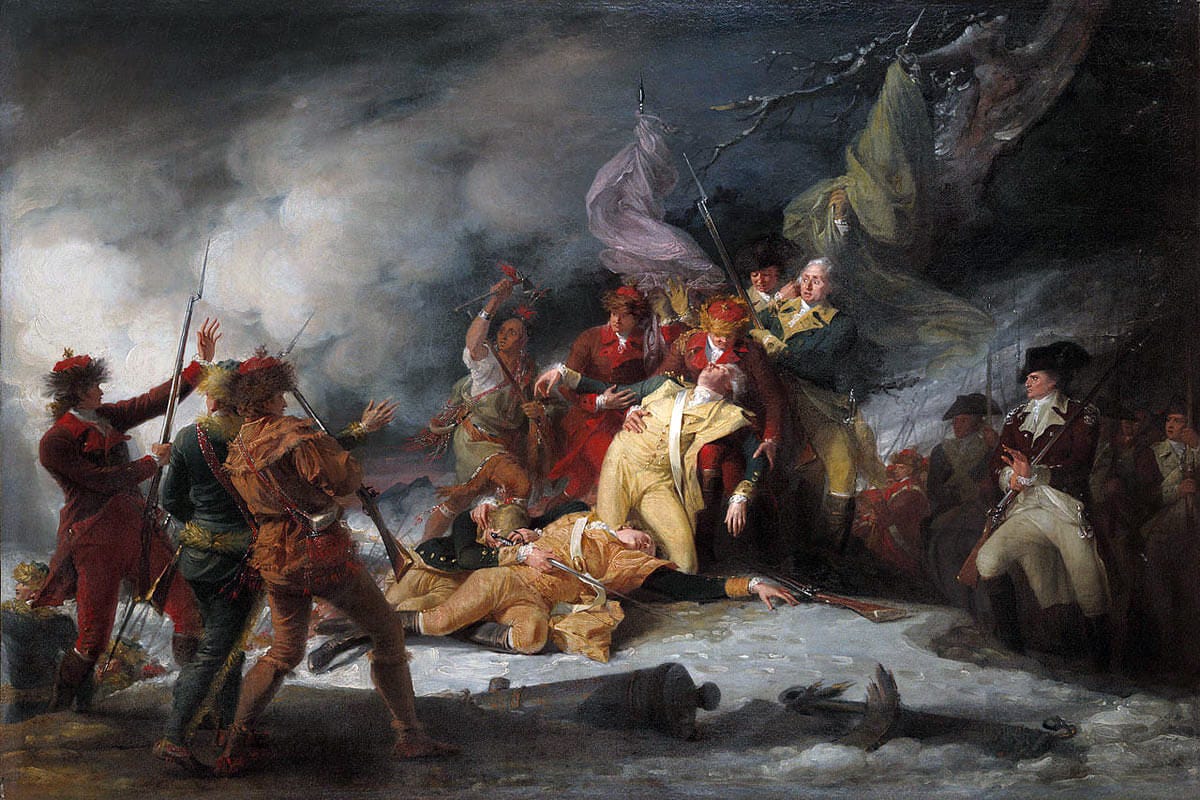
‘The Death of General Montgomery in the Attack on Quebec’, by John Trumbull (1786)
Chapter 37 - The Battle of Flamborough Head, August 23rd 1779
In France, Dr. Franklin was extremely busy. He suffered from psoriasis and boils and was stricken with gout repeatedly. He was often overwhelmed by callers and with his correspondence. He continued his discussions with academicians and scientists, like Antoine-Laurent Lavoisier, and he also joined the freemasonic lodge of the Nine Sisters. He received demands of every kind for money – for paying the interest on French loans, for furnishing and refitting ships(12), for helping half-starved and penniless exchanged former American prisoners, and for bills to support the commissioners to Vienna (William Lee) and Tuscany (Ralph Izard) who were now living in Paris, after they were not received by those governments.
In September 1778, Dr. Franklin was voted by Congress to be minister plenipotentiary to the court of France, replacing the prior arrangement and eliminating the commissions for John Adams and Arthur Lee. But Dr. Franklin would not learn of his appointment until February 12th 1779, with the arrival in France of Lafayette with dispatches from Congress – including ‘Plan of an attack upon Quebec’ and ‘Observations on the Finances of America’. Lafayette had sailed on the Alliance(13), a newly launched ship from Massachusetts and captained by Pierre Landais, who had left the French Navy to come to America.
Unable to visit Dr. Franklin(14), Lafayette sent an aide to Passy with the dispatches from Congress for Dr. Franklin and the commissioners, while he went to meet with Prime Minister Maurepas – Lafayette had been requested by Congress to submit to the French government a scheme for a joint invasion of Canada. Lafayette began a series of visits to Versailles, going door to door of the ministers, in order to further the plan – that had also now been approved of by Dr. Franklin. (Lafayette had left Boston on January 11th – too late to receive a letter from Congress that rescinded their proposal for an attack on Canada.)
On January 1st 1779, after sending a committee to confer with General Washington, Congress wrote to Lafayette that:
“although the emancipation of Canada is a very desirable object, yet considering the exhausted state of their resources, and the derangement of their finances, they conceive it very problematical whether they could make any solid impression… that movements meditated against that province are utterly impracticable from the nature of the country, the defect of supplies and the impossibility of transporting them hither”.
Congress agreed that:
“every favourable incident be embraced with alacrity to facilitate the freedom and independence of Canada and her union with these states”.
The minister of foreign affairs, the Comte de Vergennes, looked upon the conquest of Halifax and Quebec as of dubious advantage to France, while the minister of finances, Jacques Necker(15), according to Dr. Franklin,:
“is said to be not well disposed towards us, and is supposed to embarrass every Measure proposed to relieve us by Grants of Money”.
(When Necker could not stop Vergennes from bringing France into the war openly on America’s side, Necker reputedly tipped off his own banking house, enabling the firm to make a big speculative killing. Then, beginning in the spring of 1780, Jacques Necker would pursue secret peace negotiations with Britain through Paul-Henri Mallet(16) and Viscount Mountstuart(17). Necker was proposing a truce, not a peace, during which the belligerent parties in America could hold the territory that they now possessed. On December 1st 1780, Necker would write a secret letter to Lord North proposing the truce, which George III refused on December 18th. When Necker’s push for power was stopped and he was refused a seat on the Council by Louis XVI, Necker would resign on May 19th 1781.)
Lafayette would later write to Congress (on June 12th) that the plan was considered impossible for the present. While waiting for a decision, Lafayette now made the rounds of the ministers, with interviews and memoranda of a new plan, asking permission to take some 1500 or 2000 men into the Irish Sea on vessels.
Maurepas, the prime minister, gave Lafayette permission to discuss the idea with Dr. Franklin, who offered to put Captain John Paul Jones at his disposal. On March 22nd Dr. Franklin wrote to Lafayette:
“it is certain that the Coasts of England & Scotland are extreamly open & defenceless. There are also many rich Towns near the Sea, which 4 or 5000 Men, landing unexpectedly, might easily surprize and destroy, or exact from them a heavy Contribution, taking a Part in ready Money and Hostages for the Rest… And if among the Troops there were a few Horsemen to make sudden Incursions at some little Distance from the Coast, it would spread Terror to much greater Distances and the whole would occasion Movements & Marches of Troops that must put the Enemy to a prodigious Expence, and harrass them exceedingly”.
In order to preserve the element of surprise, Lafayette allowed the press to think that he was planning an expedition to America.
The minister of marine, Sartine, was quite receptive and wished to speak with John Paul Jones to command the sea forces. By the middle of May, with the help of Leray de Chaumont (Dr. Franklin’s landlord), Jones’s fleet now included the Alliance(18) and 2 other frigates, the Duke of Duras and the Pallas, a brig Vengeance, and a cutter Cerf. Landais, a Frenchman, was to be the captain of the Alliance and its American crew, while Jones, an American, was to be commander of the fleet and mostly French crew(19), and sailed in the Duras, that he renamed the Bonhomme Richard in honour of Dr. Franklin.
On June 19th Jones and his fleet finally left L’Orient, but only to escort some merchant vessels south. During a storm, the Alliance collided with the Bonhomme Richard, damaging both ships, and after they successfully performed their mission, they returned to L’Orient for repairs before Jones was able to sail again.
At this time, the French government (Montbarey, the minister of war was probably responsible) decided that Lafayette was not to proceed on the expedition with Jones, but instead to proceed to his post as commander (mestre de camp) of a regiment of the King’s Dragoons. The French were now planning an invasion of Britain.
Once Spain had declared war against Britain (on June 16th) a combined French and Spanish fleet under the Comte d’Orvilliers would establish dominance in the English Channel and a 30,000-man army under the Comte de Vaux would cross the channel and attack the island. Lafayette was to be an aide-marechal-general des logis under Jaucourt, one of the three quartermaster-generals.
While waiting in Paris for his new orders, Lafayette met with Dr. Franklin and discussed preparing a ‘little book’ dealing with British cruelty during the war in America. Lafayette also met with Edward Bancroft, who had recently returned from Ireland, and reported Bancroft’s opinions to Vergennes. (Lafayette had earlier suggested sending Bancroft, an unofficial aide to Dr. Franklin, to stir up rebellion in Ireland, as a flanking operation against the British.) After his meeting with Vergennes, Lafayette wrote his promised report on July 15th – a 15-page document proposing a 4300 man French expeditionary force to America (4000 troops, 200 dragoons and 100 hussars), beginning at Newport, Rhode Island, which appeared to him to be the best point of attack, and later possibly assisting General Washington in an attack on the British at New York. After then assisting the Americans, the French could then ask for their assistance in seizing Halifax, “the storehouse and bulwark of the British navy in the new world”.
D’Orvilliers and his fleet of 66 vessels finally reached the Channel on August 6th, after having waited in a tropical sea for 6 weeks for the Spanish squadron, where insufficient food, water and medicine led to an outbreak of smallpox. D’Orvilliers now proceeded to blockade the port of Plymouth, while the main army was to have been convoyed for an attack on Falmouth. After three days, a storm blew his ships out of the Channel, and the expedition against Falmouth had to be abandoned. Charles Hardy, with an inferior British fleet, moved into the Channel and while not allowing D’Orvilliers to come close enough to force a battle, finally eluded him and fled into Plymouth harbour. D’Orvilliers would return to Brest in early September.
Soon Lafayette would write an enthusiastic letter of congratulations to Captain Jones for his dramatic exploits in Scottish waters.
Jones was able to sail again on August 15th, and one day out, they recaptured a large Dutch ship, laden with French property. On the 20th, a brig, from Limerick to London, was taken. On the 23rd, the squadron was off Cape Clear, having doubled Scilly and passing up the west coast of Ireland, Jones placed his own barge in the water to keep the ship’s head off-shore, and sent several of the Bonhomme Richard’s boats to seize a brig. The brig was captured, and towed toward the squadron. Just at this moment, the men in the barge cut the tow-line and pulled for the shore. A boat pursued them but upon landing they were arrested – making a total loss of fugitives and prisoners of 24 men. To add to the misfortune, the Cerf got separated in the fog, and did not rejoin the squadron, but went back to France. Insubordination began to seriously show itself, at this time, and Jones had a serious quarrel with his second in command, M. Landais.
It was the intention of Jones to remain a week longer off Cape Clear, but Landais seemed so apprehensive of the approach of a superior force, that on the night of the 26th, the Alliance parted company and sailed northward. On the 31st, Jones, with the Bonhomme Richard, Pallas, and Vengeance, was off Cape Wrath, the northwestern extremity of the island of Great Britain, where he captured a heavy Letter-of-Marque, of twenty-two guns, laden with naval stores for the enemy’s vessels on the American lakes. While Jones was chasing this ship, the Alliance hove in sight, and joined in the chase, having already captured another Letter-of-Marque as a prize. At Landais’s request, these two ships were manned from the Alliance, and he sent them into Norway, contrary to orders, where both were restored to the British by the Danish government. On the night of the 8th, the Alliance again parted company, in a gale of wind.
Continuing around the northern coast of Scotland, on August 13th Jones and his squadron reached Leith, the port of Edinburgh. His intention was to land and not only to lay the place under contribution, but to seize the shipping he might find in the Forth, and maybe even frighten the Scottish capital into a temporary submission. However, his other two captains threw cold water on his views, and when the Pallas and the Vengeance gave chase to the southward, the Bonhomme Richard, being alone, had to quit the Forth, and a golden opportunity was lost, in consequence of the doubts and misgivings of his subordinates.
Still Jones determined to make the attempt. On the 15th, the Bonhomme Richard, Pallas, and Vengeance entered the Forth, but by this time, the alarm had been given on shore, and guns were mounted at Leith, to receive the strangers. A squall struck the ships and when it turned into a gale, Jones was driven out of the Forth. He then abandoned his plan, as he conceived it was too late to hope for a surprise, his only rational ground for expecting success. Jones now had new designs on Newcastle or Hull but his captains refused to support him (his object was glory, theirs appears to have been profit).
Between August 17th and 21st, many colliers and coasters were captured, and most of them were sunk. On the 21st, the ships were off Flamborough Head, and while the Bonhomme Richard and the Vengeance were pursuing vessels to the south, the Pallas chased to the northeast. After capturing a brig, Jones noticed a considerable fleet in the Humber bay. Failing to decoy them out, Jones returned north to look for the Pallas. On the night of the 22nd, 2 ships were seen, and after chasing them, the next morning the ships were found to be the Pallas and the Alliance (Jones had not seem the Alliance since Cape Wrath – 2 weeks ago).
On August 23rd, a fleet of 41 sail (a convoy from the Baltic bound for London) were seen heading southwards. Upon seeing Jones, the merchant ships sailed toward shore, while the Serapis and the Countess of Scarborough sailed out to sea to face Jones’s ships. By early evening the 42-gun Bonhomme Richard and the 44-gun Serapis drew near to each other, and exchanged broadsides. The Richard had six eighteens mounted in her gunroom. Unfortunately two of these old defective pieces burst at the first discharge, blowing up the main-deck above them, beside killing and wounding many men. The alarm was so great as to destroy all confidence in these guns and their crews abandoned them – leaving the Richard with no eighteens and only its 28 twelves against the 20 eighteens of the Serapis.
The Countess of Scarborough came up and fired a raking broadside at the Richard, but was afraid to engage, as the smoke and obscurity rendered it impossible to tell friend from enemy, and it edged away. After the Countess exchanged 2 or 3 broadsides with the Alliance, the Alliance sailed away. When the Countess headed toward the main battle to help the Serapis, it was then brought to action by the Pallas.
As the Richard and the Serapis tried to out-manoeuvre each other, the jig-boom of the Serapis caught in the mizzen rigging of the Richard. Jones saw that he had no chance in a cannonade, and gladly seized the opportunity of grappling, as he and his crew fastened the two ships together. The Serapis dropped anchor, hoping to break free from the Richard, but it was caught in the stern of the Richard, and the two ships became firmly attached, side-by-side, faced in opposite directions, with their guns touching each other’s hull planks.
The eighteens of the Serapis were fired straight into the Richard’s hull and destroyed everything within their range, tearing huge holes in its side, and doing terrible damage to the gun-decks, and it wasn’t long before the twelves of the Richard were silenced. But Jones’s men that had been driven from the cannons, now moved up to the forecastle, and kept up an incessant firing of musketry and hurling of grenades, along with firing the 2 nines on the quarterdeck at the main mast of the Serapis.
Landais, in the Alliance, not near any of the principal combatants and after observing for some time, now decided to set off after the Pallas. On the way, it passed by the Serapis and the Richard locked together, and fired a broadside, that did as much damage to the Richard as it did to the Serapis.
As Captain Piercy of the Countess saw the well-armed and unharmed Alliance approach, and with 7 guns dismounted, 4 dead, 20 wounded and her rigging and sails badly damaged, he surrendered to Captain Cottineau of the Pallas. Cottineau now begged Landais to go to the aid of the Richard.
By this time, the Richard’s gun decks were so badly damaged that most of the British shots were passing straight through without touching anything, the hold was filling with water as one of the pumps was destroyed, and there were fires everywhere. The Alliance returned, sailing around the safe sides of the two locked ships, and then the eccentric, if not insane, Landais fired broadsides into the stern of the Richard – dismounting a gun, and killing or wounding 12 men!!!
As the Richard began sinking, the 100 British prisoners on board were released, and Jones convinced them to work the remaining pumps in order to save their own lives. The British mustered a party of boarders to take possession of the Richard, but were driven back by the musketry of Jones’s men. A grenade tossed from the Richard managed to reach the lower gun deck of the Serapis and set fire to some uncovered cartridges and a huge explosion extended from the main mast aft, silencing every gun in that part of the ship, killing 20 men and wounding 40 more, and setting the ship on fire. Finally, after being lashed together and fighting for over 2 ½ hours, Captain Pearson of the Serapis hauled down his colours and surrendered. The Serapis had many more than 49 dead and 68 wounded, and the Bonhomme Richard may have had 150 killed or wounded.
Jones ordered the lashings cut to separate the two ships, and the main mast of the Serapis came down. After finally putting out the fires, he surveyed the Richard. Its side was almost destroyed by the guns of the Serapis, and nothing prevented the quarter-deck, main-deck and poop from literally falling down upon the lower-deck, but a few top-timbers and upper futtocks that had fortunately escaped destruction. Jones decided that any attempt to carry the ship was hopeless and it was determined to remove the wounded, transfer his crew to the Serapis, and to abandon ship. Jones and his fleet, along with the 2 prizes, arrived at the island of Texel, in the Netherlands, on October 3rd. The Royal Navy set up a blockade off Texel, the port of Amsterdam, and demanded that the Dutch government return the Serapis and the Countess of Scarborough to Britain, and that it expel the American squadron.
Sartine, the French minister of the navy, ordered Dr. Franklin to summon Landais(20) back to Paris for questioning, and to face 25 charges. (Dr. Franklin would lead an inquiry into Landais’s conduct, but would suspend judgement in the matter, as disciplining a French officer on French soil was highly impolitic, and Landais would have to return to America and face a court martial there.) After getting rid of Landais, Jones moved himself, the officers and crewmen from the Richard to the Alliance, and defiantly kept flying the stars and stripes, while the Pallas and the Vengeance switched to French colours.
After almost 3 months of wrangling and stalling so that he could make the necessary repairs to his ships, on December 27th Jones, in the Alliance, slipped away from Texel past the British blockade, and finally arrived back at L’Orient on February 10th 1780. While Jones was busy in Paris, attempting to reclaim the money from the sale of the prizes, and discussing with the French ministers his plan for a new squadron to raid the British coasts, the Alliance was being readied to sail to America with supplies.
In London, the ministry of Lord North, and its disastrous handling of the war with America, was in crisis. Counties were flooding the House of Commons with their demands for parliamentary reform, for universal suffrage and for diminishing the influence of the crown. (The Whigs were to mouth support for reform, while actually being used to temper these reforms.) But, efforts to form some kind of coalition government with the Whigs (with or without North, if necessary) failed.
Earlier in 1778, the North ministry had proposed a Catholic relief act – to counteract an anticipated exodus of farm tenants in Ireland, that was feared might result from the thousands of handbills distributed at the instigation of Charles Carroll, that offered land grants and toleration to those who ventured to come to America. This relief act was supported by the Whigs, who sought to keep their tenants on their vast land holdings in Ireland. With starving Dublin crowds, muttering against trade restrictions and besieging the Irish parliament for relief, North would propose a trade relief bill for Ireland in December 1779.
After the threatened invasion of Britain by France and Spain, rumours were now spread of a conspiracy among the Popish powers to enslave Britain and to establish an inquisition in London. Lord George Gordon, president of the Protestant Association of England, was used to stir the cauldron of discontent. On June 2nd 1780, Gordon was to present a petition to the House of Commons, and called for the Protestant Association to accompany him. 60,000 persons assembled and marched into Westminster Hall, laid siege to Parliament and attacked anyone suspected of having had a hand in the passage of the Catholic Relief Act. The ‘Gordon riots’ raged for eight days. Gossip tried to place the blame on France or America.
Parliament was dissolved and new elections were held – resulting in a timely and fortunate majority government for North, and ending any talk of a coalition government. And also ending any talk of reform.
In America, on March 23rd 1779, the Committee on Foreign Affairs of Congress had brought in a report concerning complaints of the conduct of its commercial agent and its several commissioners, and of the ‘suspicions and animosities’ among the commissioners – Benjamin Franklin, Silas Deane, Arthur Lee, Ralf Izard and William Lee. (In December 1778, Silas Deane, angry at his earlier recall from France, began a public attack in the press against Izard and the Lee brothers. With a hatred of Deane and a jealousy of Dr. Franklin, Arthur Lee replied with attacks on both Deane and on Dr. Franklin.) The report listed 10 charges against Deane; 7 charges against A. Lee; 5 charges against W. Lee; 1 charge against Izard –
“that not being able to proceed to the court of Tuscany… has remained in Paris, and that the greater part of his time has been spent in altercations with Mr. Franklin, and writing letters to Congress replete with criminations of Mr. Franklin(21) and Mr. Deane”;
and 1 charge against John Adams – that he ‘threatened Mr. Izard with the displeasure of Congress’.
Also in the report, were 3 charges against Dr. Franklin by A. Lee and Izard -
“that Mr. Benj. Franklin withheld information from Mr. A. Lee; that Mr. Franklin, from a partiality to his nephew, Mr. Williams, and his friend, Mr. Chaumont, concurred with Mr. Deane in systems of profusion, disorder and dissipation in the conduct of public affairs; and that Mr. Franklin is not a proper person to be trusted with the management of the affairs of America, that he is haughty and self sufficient and not guided by principles of virtue or honor.”
As a result of the intense debates in Congress over this report, on June 8th Congress recalled both William Lee and Ralph Izard, and directed Arthur Lee to repair to America ‘in order the better to enquire into the truth of the several allegations and suggestions’ made by him in his correspondence with Congress against Deane.
And in France, on June 15th 1779, Congress had written a letter to his most Christian Majesty (i.e. France) requesting arms, ammunition, clothing and supplies needed to continue the war. In September, Dr. Franklin had presented the 38-page inventory list to Vergennes, and after he had succeeded in procuring a 3 million livre loan from France, he began purchasing the desperately needed supplies, to be shipped in the Alliance, that would also return Arthur Lee and Ralph Izard to America. On September 27th 1779, Congress had elected John Adams to be ‘a minister plenipotentiary for negotiating a treaty of peace and a treaty of commerce with Great Britain’, and also elected John Jay to be ‘a minister plenipotentiary to negotiate a treaty of alliance and of amity and commerce between the United States of America and his Catholic Majesty’ (i.e. Spain) – which put Arthur Lee out of a job!
Arriving in L’Orient to seek passage back to America, Landais met Arthur Lee, who was also there seeking passage home. Lee convinced Landais that since he held a commission from Congress, Dr. Franklin didn’t have the authority to relieve him of command!!! On June 12th 1780, Landais boarded the Alliance, convinced its crew to mutiny against the rest of the crew from the Bonhomme Richard, assumed command, and weighed anchor (while being only partly loaded with the American supplies).
On June 20th, Jones returned to L’Orient with orders from Sartine for Thevenard, the commanding officer of the port, to alert the warships and forts, and to barricade the entrance to the port, in order to detain the Alliance and to imprison Landais. Landais, on the advice of Lee(22), refused to obey the order and instead ejected Jones’s officers from the ship and placed his crew from the Richard in irons. Thevenard then signed the order to fire on the Alliance if it tried to put out to sea. Not wanting to show the British any appearance of disagreement between the Americans and the French, and not wanting to dishonour the American flag (being flown by the Alliance), and not wanting to spill any American or French blood (simply in order to give himself a command) Jones begged Thevenard to retract his order and open the entrance to the port. But Landais now refused to sail or to return to port without his prize monies.
On July 7th the Alliance finally sailed away to America. But on the voyage, Landais quarrelled with his officers, abused his crew and made life miserable for his passengers, until he was forcibly relieved of command. The Alliance arrived at Boston on August 19th. In November, Landais was court-martialed, found guilty and removed from service.
Footnotes for chapter 37:
(12) The commissioners in France had ordered a frigate, the Indien, to be built in Holland and to be given to John Paul Jones. Jones had sailed in the Ranger, leaving Portsmouth, N.H. on November 1st 1777, and arrived at Nantes in France on December 2nd. But before his arrival, pressure from Great Britain on the still-neutral Dutch government had forced the commissioners to transfer the new frigate to France. Jones, in the Ranger, sailed from Brest on April 10th 1778 in a bold raid along the east coast of Ireland, and, after an attempt to burn the ships at Whitehaven on the west coast of Britain, he captured a British ship, the Drake, before returning to Brest on May 8th. The Ranger later returned to America, and Jones remained in France trying to obtain a ship.
(13) On February 2nd, on the trip to France, an attempt at mutiny against Captain Landais – a plot to seize the ship by 38 men, was uncovered and stopped, and the 38 men were put in irons for the remainder of the voyage.
(14) Lafayette was under orders to see no one but relatives – he had gone to America, against the king’s wish, and now must bear a penalty – a week of confinement at the home of his wife’s grandfather, the Duc de Noailles, before he could visit Dr. Franklin.
(15) Jacques Necker was a citizen of Geneva, not of Switzerland. Geneva was an oligarchicaly-controlled city-state (like Venice), that would become a member of the Swiss confederacy, as part of the settlement of the Congress of Vienna in 1815.
(16) Paul-Henri Mallet, an historian from Geneva who was writing a history of Brunswick for George III, had been an intimate, since childhood, with Necker, a fellow Genevan.
(17) Mountstuart, the son of Lord Bute, had spent some time in his youth in Geneva, and Mallet was his former tutor.
(18) Adams was supposed to have sailed earlier on the Alliance but Sartine instead assigned the ship to Jones’s squadron. No longer a commissioner, Adams returned home and sailed from France on June 17th along with America’s new French ambassador.
(19) Many of the just exchanged American seamen agreed to join Jones on the Bonhomme Richard.
(20) Landais had ignored all of Jones’s signals, and had, at one time, even threatened to kill Jones. Before leaving Texel, Landais fought a duel with Cottineau, who had called him a coward.
(21) Dr. Franklin wrote a satire in which he reduced Izard to the letter Z, “a little, hissing, crooked, serpentine, venomous” entity, obsessed with his placement in the alphabet, which he considers consistent neither with his station nor with his ability, and, intent on redress, Z petitions for nothing less than a wholesale reform of the alphabet.
(22) Suspecting Mr. Lee was at the bottom of this affair, on June 20th, Jonathan Williams (Dr. Franklin’s grand-nephew) fought a duel with Lee. Lee missed his shot, and Williams fired out the window. Dr. Franklin predicted of Lee that “if some of the many enemies he provokes, do not kill him sooner, he will die in a madhouse”.
[next week - Part 6 - 1780, the Road to Treason, chapter 38 - The Battle on the Frontier, Spring 1780]
*************
For those who may wish to support my continuing work on ‘The Unveiling of Canadian History’, you may purchase my books, that are available as PDFs and Paperback (on Amazon)
Volume 2 – Forlorn Hope – Quebec and Nova Scotia, and the War for Independence, 1775 – 1785.
Volume 3 – The Storming of Hell – the War for the Territory Northwest of Ohio, 1786 – 1796.
And hopefully,
Volume 5 – On the Trail of the Treasonous, 1804 – 1807.
may also appear in print, in the near future, while I continue to work on :
Volume 6 - Through the Perilous Fight, 1807 – 1814.