Forlorn Hope - Chapter 19
The Battles of Bennington, August 16th, and of Fort Stanwix, August 24th 1777

The Unveiling of Canadian History - Volume 2
FORLORN HOPE
Quebec and Nova Scotia, and the War for Independence, 1775 – 1785
Part 3 - 1777, the Road to Saratoga
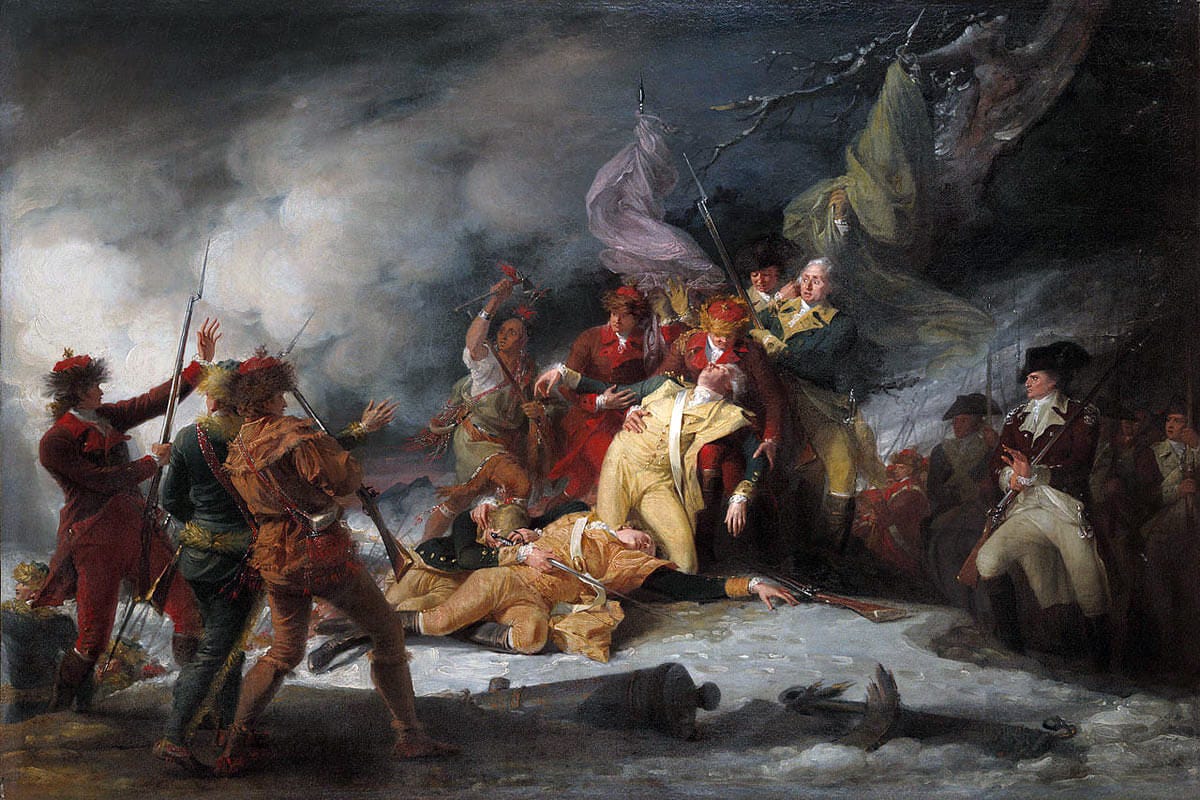
‘The Death of General Montgomery in the Attack on Quebec’, by John Trumbull (1786)
Chapter 19 – The Battles of Bennington, August 16th, and of Fort Stanwix, August 24th 1777
On July 24th, General Washington now learned that Howe had embarked 36 British and Hessian battalions (almost 18,000 men), while leaving Henry Clinton behind with 17 battalions for the protection of New York, and had finally set sail on July 23rd. Thinking that Howe was now moving to attack Philadelphia, General Washington set out with his army from the Clove for the Delaware, and halted at Trenton until he could be more certain of Howe’s destination. General Washington also ordered Sullivan (including Hazen and the 2nd Canadian regiment) and Maj-General Stirling with their divisions to cross the Hudson from Peekskill and proceed to Pennsylvania, and then ordered Putnam to move two brigades across the river to be kept in readiness in case he needed them too.
On July 31st, General Washington received news that Howe had arrived at the Capes of Delaware, and ordered Putnam to send the two brigades. But Howe was deterred from entering the Delaware river by reports of measures taken to obstruct its navigation, and the British fleet sailed out of the Capes and apparently shaped its course eastward. This caused General Washington to fear that Howe may be planning a move up the Hudson to join Burgoyne, and while he remained with his army near Germantown, he now ordered Sullivan, with his division (including the 2nd Canadian regiment) and the two brigades, to hasten back to recross the Hudson to Peekskill.
Schuyler, finding his position at Moses Kill untenable, and being under constant attacks from the Indians, moved his army first to Fort Miller, then to Saratoga on July 31st, and later to Stillwater. At Fort Miller, Major-General Lincoln arrived, and Schuyler sent him to Manchester in Vermont to take command of the troops gathered there by Colonel Warner. At Saratoga, Brigadier-General Glover and 1200 men now arrived, but Colonel Long and his New Hampshire regiment left as their time was up, and Poor’s New Hampshire militia followed, leaving Schuyler with about 3000 troops.
On August 16th, General Washington sent Morgan’s Corps of Riflemen (500 men) to Schuyler, to allay the northern army’s fear of Burgoyne’s Indians. And Putnam sent Van Cortland’s and Livingston’s New York Continental regiments to Schuyler.
On August 10th, Schuyler received from Congress a copy of a resolution passed on July 31st ‘that an inquiry be made into the reasons of the evacuation of Ticonderoga and Mount Independence, and into the conduct of the general officers who were in the Northern Department at the time of the evacuation’ and a copy of a resolution passed on August 1st ‘that General Washington be directed to order such general officer as he shall think proper to repair immediately to the Northern Department, to relieve Major-General Schuyler in his command there’. Schuyler was ordered to repair to headquarters, but Schuyler felt that it was his duty to remain with the army until his successor should arrive in camp. On August 13th, Schuyler moved his army further south to the Sprouts, the islands at the fords of the Mohawk river, where it empties into the Hudson.
In answer to an urgent request from Ira Allen of Vermont, the General Court of New Hampshire voted to raise a militia brigade under the command of John Stark(11), who was voted a Brigadier-General, and send it to Bennington, and join with Warner’s men, to defend the frontier from a possible attack by Burgoyne’s army. By August 13th, Stark had over 1000 men, including the Vermont militia, at Bennington and about 100 men in Warner’s regiment at Manchester. Schuyler’s plan was to send Lincoln and 500 men to join Stark and Warner, and to harass the enemy at its rear.
Burgoyne had set up his headquarters at Fort Edward, having finally reached the head of navigation on the Hudson river. But the surrounding countryside had been thoroughly stripped of food and forage by the retreating Schuyler, and the British supplies had to be brought from Fort George and Skenesborough with no oxen or horses available. Hearing that the Americans had gathered a large quantity of horses and carriages for use of the northern army at Bennington, Burgoyne made an attempt to seize them, and at the same time to block an attack on his left flank from New England.
On August 9th, Lieutenant-Colonel Baum, with 850 Hessians, 500 Tories and with 100 Indians, left Fort Edward and marched toward Bennington. On August 13th, Stark received word that some Indians and a large party (Baum’s advance troops) had reached Cambridge. Stark sent a reconnaissance force of 200 men under Lieutenant Colonel William Gregg to intercept them, and that night they arrived at the grist mill at St. Croix. Gregg withdrew the next morning, when Baum’s forces marched into the town and seized the mill, along with 78 barrels of flour. As Gregg retreated back to Bennington, he was followed closely by Baum, who had to stop when he saw Stark coming to Gregg’s aid. Baum dug in and waited for reinforcements from Breymann (550 men – a company of riflemen and a battalion of light infantry).
Stark’s plan was to encircle the British camp and hit it on all sides at once. On August 16th, Colonel Thomas Stickney and Colonel David Hobart from New Hampshire would attack the Tory redoubt, while Stark and 300 men stormed the enemy center in a frontal attack. Lieutenant Colonel Moses Nichols of New Hampshire led 350 men north, going around to attack the rear of the dragoon’s redoubt, while Colonel Samuel Herrick from Vermont led 300 men south across the Walloomsac river to attack from the other side of the redoubt.
Within minutes, they were within the redoubt – the men firing the cannon were killed or wounded, the garrison was overwhelmed and the Hessians fled, pursued by the Americans. The Tory redoubt too was routed and the loyalists fled while being pursued. After the redoubts fell, they joined Stark’s forces for an attack on Baum. When the out-numbered Hessians finally ran out of ammunition, Stark’s forces pored over the defences, and forced the Hessians to flee to a nearby field, where in a last desperate charge, Baum was wounded and taken prisoner and the remaining Hessians surrendered. Breymann’s troops arrived and the Americans, tired from the two-hour battle, had to quickly form a skirmish line, and with the Hessians firing two six-pounders, had to slowly fall back, dodging from tree to tree.
Major John Rand and his militia from Worcester county, Massachusetts arrived along with Major Samuel Safford and Warner’s Green Mountain Boys. They now charged the Hessians, who suddenly turned and ran, with their own cannons being turned and fired on them, as they were pursued until dark. The British and Hessian loss was over 200 dead and 700 taken prisoner, and the Indians under St. Luc and Langlade declared their intention to return home. The Americans had 30 dead and 40 wounded.
As a result of this victory, Congress gave Stark a commission as a ‘brigadier in the army of the United States’, and the General Court of New Hampshire presented him with ‘a compleat suit of Clothes’.
On June 23rd, Lieutenant Colonel Barry St. Leger left Lachine with 200 men (100 British regulars from the 34th regiment, 50 Hessian jaegers, Captain J.B. de Rouville and a company of 50 men from Samuel McKay’s Canadian militia), and proceeded up the St. Lawrence river to Lake Ontario and then on to Oswego. On July 14th, a detachment of 300 men from Fort Niagara would join them at Oswego (Lieutenant Henry Bird and 100 men of the 8th regiment, 133 men of Sir John Johnson’s King’s Royal Regiment of New York, and Colonel Daniel Claus and Major John Butler, Indian Department agents, with 67 rangers) along with Joseph Brant and about 800 Indians.
Thayendanega, called Joseph Brant, was a Mohawk warrior, whose sister Mary had been married to Sir William Johnson. In May 1775, Brant left for Montreal with Guy Johnson and Daniel Claus, and also travelled with them in November to London, returning in the summer of 1776. Brant then travelled throughout the Mohawk villages, urging them to abandon their treaty of neutrality with the Continental Congress and take up arms with the British, before finally arriving at Fort Niagara with 300 Mohawk warriors. John Butler, a Mohawk valley loyalist, who also had fled to Canada with Guy Johnson, and now a British deputy Indian agent at Niagara, had convinced the Senecas to join the British in the war. Butler travelled to Oswego with 200 Seneca warriors to meet St. Leger, and was joined by warriors from the Cayugas and Onondagas at Oswego. The British Indian Department had split the Iroquois Confederacy.
Together, the British and Indian force would travel from Oswego to Fort Stanwix (now Fort Schuyler). (In July 1776, at the urging of the Oneidas, who would remain allies of the Continental Congress, the Americans reoccupied Fort Stanwix, and Colonel Dayton of the 3rd New Jersey regiment – the first garrisons of the fort, renamed it Fort Schuyler.) The fort, at the head of navigation on the Mohawk river, was manned by 550 men of the 3rd New York Continentals under Colonel Peter Gansevoort. The Oneidas, who were dispersed as pickets and spies throughout the woods around the fort, warned Gansevoort of the approach of the British, the advance led by Butler and Brant. (Some of the Oneidas helped defend the fort while other Oneida sought refuge inside of the fort.)
By August 2nd, St. Leger reached Fort Schuyler, encamped the regulars and artillery north of the fort, and the Indians and loyalists to the south. St. Leger had arrived too late to stop the arrival of new supplies for the fort – supplies that were guarded by 200 men from the 9th Massachusetts, now also inside the fort. Oneida messengers, slipped through the British lines, and made their way to Fort Dayton to warn the Americans. Hearing of the siege, the Tryon County Committee of Safety assembled an 800-man militia under Brigadier General Nicholas Herkimer at Fort Dayton that marched to relieve the fort. At Oriska, an Oneida village, over 60 Oneida warriors joined with Herkimer’s militia.
St. Leger ordered Johnson, with a company of light infantry, and Butler, with 30 rangers, 200 Seneca and 100 Mohawk warriors, to intercept Herkimer. Johnson chose a ravine near the Indian village of Oriskany, where the only road wound through the small ravine. On August 6th, as Herkimer led his men through the ravine, they were ambushed by the Indians and British. After a murderous battle with over 450 of his men either dead or wounded, a wounded Herkimer led a retreat of his men back to Fort Dayton, where he later died. The British had 150 dead or wounded – among the dead were three dozen Seneca, and perhaps an equal number of Mohawk. (The Oneida losses are unknown).
At Fort Schuyler, Lieutenant Colonel Marinus Willett led 250 men from the fort and raided the deserted camps of the Indians and loyalists, taking their provisions and their personal belongings – including brass kettles, blankets, muskets, tomahawks, spears, ammunition and clothing, and returned to the fort without suffering any casualties.
St. Leger continued the seige of the fort with musket and cannon fire, while Oneida scouts, outside the fort, continued to harass the British. St. Leger then demanded the fort to surrender, with threats that the Indians would be permitted to massacre the garrison and to destroy the Mohawk valley communities. Taking advantage of this brief truce, Gansevoort sent Willet to notify Schuyler of their situation. Oneida scouts also gave Schuyler estimates of the number of British forces beseiging the fort. On hearing the news of Oriskany, Schuyler held a council of war, and then sent Arnold(12) to lead a detachment of 900 men from the 4th Massachusetts under Brigadier general Ebeneezer Learned (including the 1st Canadian regiment)(13) to relieve the besieged fort.
At Fort Dayton, Arnold had a plan to help in the relief. Among the prisoners recently captured and condemned to death for planning an uprising in Tryon county in support of St. Leger’s invasion, was a half-witted (partially-insane) dutchman, named Hon-Yost Schuyler who the Mohawks revered as someone protected by the Great Spirit – they believed that the Great Spirit talked to the insane, who might be prophets.
Arnold offered Hon-Yost a pardon if he would go with two Oneida Indians, to St. Leger`s Indian camp and spread the word that Arnold was approaching with an overwhelming force of more than 2000 men. Hon-Yost agreed and they started for Fort Schuyler, arrived at the Indian encampment and spread the news. The Indians were deeply agitated by this report. Already unhappy at the slow pace of the siege, the paucity of scalps and plunder, at having all their belongings stolen by the Americans, and now being told by the two Oneidas that Dark Eagle, as Arnold was called by the Abenakis, was coming to punish only the British and not the Indians who did not oppose him, the chiefs could not be persuaded to stay any longer, and after looting some of the British supplies and liquor, left to return home. Deserted by their allies, St. Leger feared that he now had too small a force left to hold out against the large force coming under Arnold, and that his men were tired from the two weeks of laying siege to the fort, and so ordered his men to take what they could carry on their backs and retreated to Oswego.
While retreating, the British-allied Iroquois attacked the Oneida village of Oriska – burning the houses, destroying the crops, killing the cattle and forcing the women, children and elderly who had been left there to flee into the woods. In retaliation, the Tryon County militia along with some Oneida warriors attacked the Mohawk village of Canajoharie, taking any valuables, and seizing the livestock and crops, and forcing the residents to flee to Oswego and Niagara. Later, most of the Indians at Tiononderoga, the other Mohawk village, fled to Canada, before that village was pillaged too.
Arnold left Fort Dayton on August 21st and arrived at the Oriskany battlefield on the 22nd, where he ordered Livingston and the 1st Canadian regiment to bury the dead of the Tryon county militia who had been killed in that battle, but unfortunately the bodies were in such a bad way due to the hot weather, that they could not be buried. After a forced march of 22 miles on August 24th, Arnold arrived at Fort Schuyler with nearly 1000 men, having relieved the siege without firing a shot. Arnold sent out a party of Oneidas and 500 troops to pursue the British as far as Oneida lake, before turning back because of heavy rains. After leaving two militia regiments to support the garrison, Arnold marched east to rejoin the army at Stillwater, where he learned that he had a new commanding officer – Horatio Gates.
On August 19th, Gates had arrived to take command of the Northern Army. St. Clair immediately left to see General Washington at headquarters. Schuyler returned to Albany where he remained, hoping to be of assistance to Gates, and also hoping as commissioner of Indian Affairs, to try to keep the Iroquois to their promised neutrality.
On September 15th, Schuyler held a council with 300 Iroquois, mostly Oneidas and Tuscaroras, and they agreed to a declaration of war against the British. On September 19th, 150 Oneida warriors would travel to Bemis Heights to join Gates’s army. They would harrass Burgoyne’s army, capturing any British troops they could, and later exchanging them for the release of those Iroquois that had been captured by the Americans – in hope of proving their desire for peace to the other Iroquois tribes.
Footnotes for Part 3, Chapter 19.
(11) When his name was not on the list of new Brigadier generals appointed by Congress in February 1777, Stark resigned from the Continental army. He was now a brigadier general, but answerable to New Hampshire, not to Congress.
(12) When Schuyler asked for a brigadier to lead the mission, no one stepped forward, and Major-general Arnold volunteered.
(13) On July 20th, Livingston and the 1st Canadian regiment had been ordered from Fort Johnstown to join Learned’s brigade.
[next week - chapter 20 - The Battle of Brandywine, September 11th 1777]
For those who may wish to support my continuing work on ‘The Unveiling of Canadian History’, you may purchase my books, that are available as PDFs and Paperback (on Amazon) at the Canadian Patriot Review :
Volume 1 – The Approaching Conflict, 1753 – 1774.
Volume 2 – Forlorn Hope – Quebec and Nova Scotia, and the War for Independence, 1775 – 1785.
Volume 3 – The Storming of Hell – the War for the Territory Northwest of the Ohio, 1786 – 1796.
And hopefully,
Volume 4 – Ireland, Haiti, and Louisiana – the Idea of a Continental Republic, 1797 – 1804,
may also appear in print, in the near future, while I continue to work on :
Volume 5 – On the Trail of the Treasonous, 1804 - 1814.