
The Unveiling of Canadian History - Volume 2
FORLORN HOPE
Quebec and Nova Scotia, and the War for Independence, 1775 – 1785
Part 3 - 1777, the Road to Saratoga
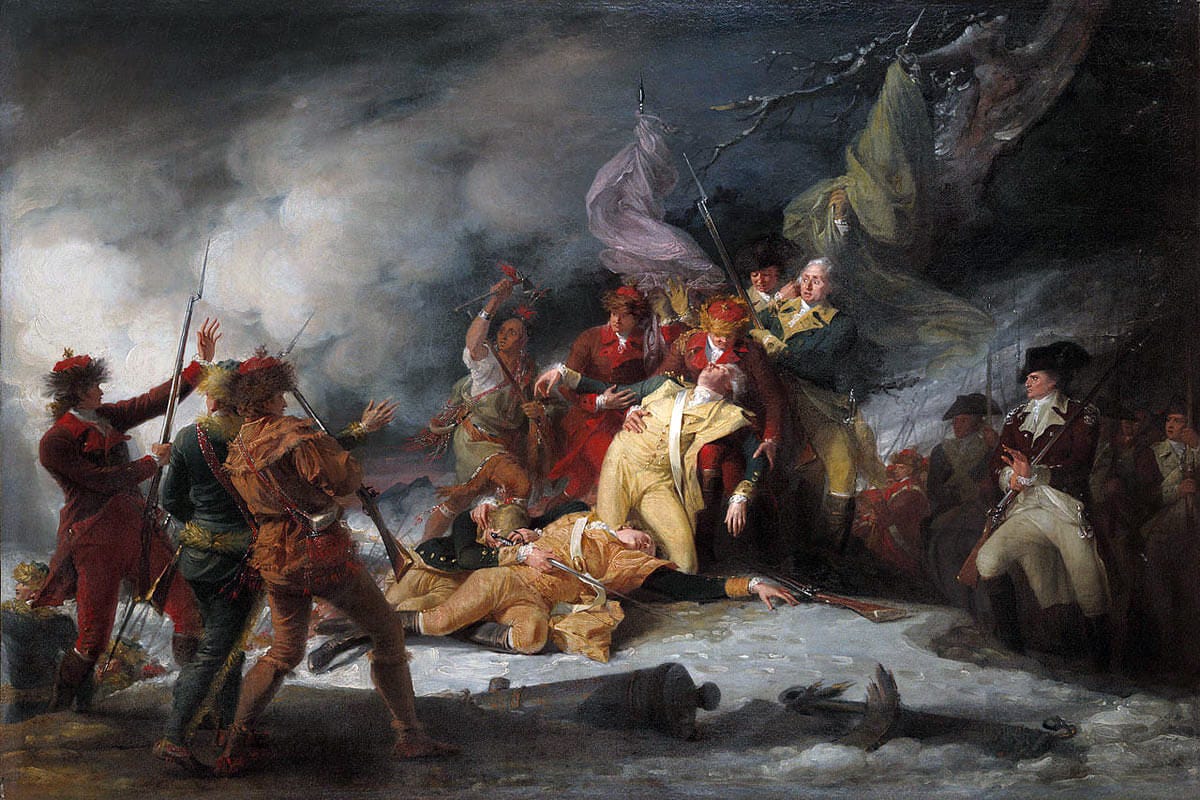
‘The Death of General Montgomery in the Attack on Quebec’, by John Trumbull (1786)
Chapter 18 – The Retreat from Ticonderoga, July 6th 1777
On the first of April 1777, three ships with supplies from ‘Roderigue Hortalez et Compagnie’ eluded the British fleet and arrived in Portsmouth, New Hampshire – 30,000 muskets, 400 tons of gunpowder, 5000 tents and 60 artillery pieces.
On April 25th 1777, William Tryon (former royal governor of New York) and 1500 British regulars and 300 of the Prince of Wales Regiment (formed by loyalists in Connecticut who had fled behind British lines on Long island) had landed at Cedar Point, at the mouth of the Saugatuck river – three miles east of Norwalk. The next day they marched to Danbury (the main supply base in Connecticut that served the American forces in the Hudson river valley), drove off the militia there under Colonel Cooke and set fire to the ammunition and supply depots. General David Wooster, now commander of the Connecticut militia, along with General Benedict Arnold, left New Haven for Fairfield and then rode to join the 500 Connecticut militia and the 100 Continental Army soldiers assembled under General Gold Silliman at Bethel, two miles from Danbury. The next morning, the British burnt more than twenty houses that belong to patriots, and marched toward Ridgefield.
Arnold and Silliman, with 400 men, went to Ridgefield, met another 100 militia-men and began erecting barricades on the road through town, while Wooster and the other 200 men, in order to gain time for Arnold and Silliman, chased and attacked the British rear guard, killing 2 and taking 40 prisoners. While rallying his men, Wooster was mortally wounded, and died five days later at Danbury. Arriving at Ridgefield, the British launched an hour-long artillery barrage of the barricade, and then advanced on three fronts – at the barricade and both flanks at the same time. Outnumbering the Americans three to one, the British breached the barricade and soon gained the town. While withdrawing his men, Arnold was pinned when his horse was killed, but he still managed to escape with an injury to his leg.
On April 28th, the British left Ridgefield after burning six more houses and the church (which had been used by the Americans as a supply depot and field hospital), and marched toward their ships. With the arrival of more militia from Connecticut and from New York, the Americans regrouped, and Silliman with 500 men began a swarming harassment of the British column as it retreated southward. Arnold gathered 500 more men and a company of artillery under Colonel John Lamb, and were positioned further south at a bridge crossing the Saugatuck river, where they attacked the oncoming British, trying to entrap them before they reached the beach. Arnold again had his horse shot from under him. The British troops were rescued by a reinforcement of Royal Marines from their fleet, whose bayonet charge caused the Connecticut militia to scatter, and who provided cover for the troops to embark and sail back to New York. At the end of the fighting, the British had 26 killed, 29 missing and 117 wounded, while the Americans had 20 killed and 40 wounded. On May 2, Congress promoted Arnold to Major General(6) on account of his bravery.
On May 6th, Burgoyne arrived back at Quebec from London with new orders for Carleton from Lord Germain, Secretary of State for the Colonies. Burgoyne would now be in command of the British army that would leave Canada, travel down lake Champlain, seize Crown Point and Ticonderoga, and force his way to Albany, where he would join up with Howe. Burgoyne had over 7000 regular troops (3981 British regulars, 3116 Hessians, and 473 British and Hessian artillerymen), along with 400 Indians. As a diversion, Lt.-Colonel Leger was to travel to Oswego, attack Fort Stanwix, march down and ravage the Mohawk river valley, and then meet up with Burgoyne at Albany. St. Leger would have about 2000 men (200 British regular troops, 500 Wirtemburg Chausseurs, 50 Quebec militia, 133 tories, 67 rangers and 1000 Indians).
[Note: These 50 Quebec militia-men, the only Canadians to see action against the Americans during the war, did not actually do any fighting. They were used to clear and build roads only. It seems Burgoyne did not trust Canadians.]
At Quebec, Carleton would be left with 3000 troops. Carleton had to resort to the corvee, to force the Canadians to help in transporting the rest of the needed provisions, ammunition and baggage to St. Jeans – it took an entire month! Instead of the two thousand Canadian militia that Burgoyne had requested, Carleton was only able to form three companies(7) of 100 men each!
On May 31st, 18 transports of British reinforcements arrived at New York. Howe now moved his headquarters to Brunswick. General Washington moved his camp from Morristown to Middlebrook, and then ordered Maj-General Putnam to send most of the continental troops from Peekskill to Morristown.
Colonel Moses Hazen and the Second Canadian Regiment, after spending the winter at Fishkill, were sent to Maj-General Putnam at Peekskill, but then were re-assigned to Maj-General Sullivan, who had asked General Washington if Hazen’s regiment could remain with him, and they arrived at Princeton on June 1st. Colonel James Livingston and the First Canadian Regiment had been sent to the Mohawk valley to garrison Fort Dayton and Fort Johnstown. The detachment at Fort Dayton was relieved by the 3rd New York regiment on May 24th, and joined the rest of the 1st Canadian regiment at Fort Johnstown.
On June 13th, Howe advanced his troops to Somerset court-house, and later Howe would feign a move towards Philadelphia to try and draw out Washington’s army into the open. General Washington, however, with the present state of his forces, did not want to risk a general action against the British, but decided instead to follow on Howe’s rear if he moved toward Philadelphia, and to keep the troops under Major-Generals Mifflin and Arnold along the west side of the Delaware river to block any British attempt to cross the river. Unable to draw out Washington’s troops into battle, on June 19th Howe returned to Brunswick, burning houses along the way.
On June 22nd, Howe now marched out of Brunswick to Amboy, burning more houses along the way, trying to provoke an attack from the Americans, but General Washington again fell to Howe’s rear and flanks. Cornwallis, making a circuitous march to the north, fell in with Major-General Stirling’s division, and after a sharp skirmish, Stirling retreated into the hills. Cornwallis moved on to Spanktown, again burning houses and plundering all before them. Unable to draw out General Washington’s forces from their strongholds, at the end of June, Howe returned to Staten Island and evacuated his troops from the Jerseys.
On June 14th, Burgoyne embarked on the 14-gun Maria, to leave Fort St. Jean, along with the rest of his navy – the bomb ketch Thunderer, the 22-gun Inflexible, the 12-gun Carleton, the 7-gun Loyal Convert and the newly built 26-gun Royal George. (Burgoyne’s train included 138 guns, from 24-pounders to 4 in. mortars).
Burgoyne’s advance corps, the 24th regiment under General Fraser, had left camp at the end of May. Fraser also had in his regiment the King’s Loyal Americans led by Ebenezer Jessup, a New York tory, and the Queen’s Loyal Rangers led by John Peters, a Connecticut tory. They were followed by Burgoyne’s right wing under Major General Phillips – the first brigade of the 9th, 47th and 53rd regiments, and the second brigade of the 20th, 21st and 62nd regiments; and then by the left wing under Riedesel – the first brigade of the von Rhetz, von Riedesel and Specht regiments, and the second brigade of the Prinz Friedrich and the Hesse-Hanau regiments, one dragoon regiment, one grenadier regiment, and an advance corps of jaegers.
Each day a regiment would move forward, landing at night at the campsite of the regiment that had gone before, until reaching the rendezvous at Cumberland bay.
On June 12th, 39 vessels had arrived at Quebec – including 15 transports with 11 companies from Britain and with 400 chausseurs from Hanau for Riedesel.
On June 12th, Major General St. Clair arrived to take command of Ticonderoga. The troops that had been garrisoned there in November, had left when their enlistment time expired. They had been replaced with about 2500 men – all from New England. From New Hampshire were Colonel Pierse Long’s regiment and three newly arrived regiments of Colonel Cilley’s 1st, Colonel Hale’s 2nd and Colonel Scammell’s 3rd, along with Whitcomb’s Rangers. From Massachusetts were Colonel Marshall’s 10th, Colonel Francis’s 11th, Colonel Brewer’s 12th and Colonel Bradford’s 13th regiments, along with Colonel Jackson’s regiment, Leonard’s militia regiment and Well’s militia regiment. And from the New Hampshire Grants came Colonel Seth Warner’s regiment.
[Note: the New Hampshire Grants would later become the state of Vermont. Warner’s men were called the Green Mountain Boys]]
Colonel Jeduthan Baldwin, the army’s engineer, assisted by Colonel Thaddeus Kosciusko (a Polish volunteer) was directing his 200 artificers in the building and repairing of the ships, the redoubts and the batteries, and also in constructing a 400-yard boom of logs and a floating bridge across the lake connecting Fort Ticonderoga and the fort at Mount Independence.
On June 20th, Schuyler(8), who had been replaced by Gates (in March) but had been re-appointed by Congress (in May) as head of the Northern Army, visited Ticonderoga and held a council with Maj-General St. Clair and with generals Fermoy, Poor and Patterson. It was decided that the safety of the troops, cannon and stores was paramount, and it was “prudent to provide for a retreat” if needed.
On June 20th, Burgoyne sailed in the Maria to meet up with Fraser’s advance troops at Bouquet river, and held a congress with the 400 Indians. On June 24th, Burgoyne’s main army left Cumberland bay and moved toward Crown Point. On June 25th, Fraser’s advance troops arrived at Crown Point and prepared for an assault landing, but found the fort was deserted. On June 30th, Fraser was now within sight of the fort at Ticonderoga, and with the main army now at Crown Point, Burgoyne began moving, with Riedesel and his Hessians advancing up the east shore of the lake toward Mount Independence, while Phillips and the British regulars advancing up the west bank towards Ticonderoga.
When intelligence of the British appearance on lake Champlain reached General Washington, however, he could not move all his troops to Peekskill, because he had to be ready to move towards Pennsylvania, if Howe again tried to attack Philadelphia. But at the same time, he had to be ready to move to the Highlands, if Howe tried to ascend the Hudson river to link up with Burgoyne coming down from Canada. General Washington then moved his remaining troops from Middleton back to Morristown (almost all of the Jersey militia had been dismissed because it was their harvest time), and ordered Varnum and Parsons with a couple of brigades to Peekskill.
Sullivan was ordered to move his division (including Hazen’s Canadians) towards the Highlands as far as Pompton, and ordered Putnam and George Clinton to call out the New York and Connecticut militias, and that when these reinforcements arrived to send four Massachusetts regiments to the aid of Ticonderoga.
On July 2nd, from Three Mile Point on the west side of Lake Champlain below Ticonderoga, Fraser sent 600 regulars along with the Canadians and Indians to go around the American left, trying to reach the sawmills along the portage road from Lake George, and thus to cut off their escape route to Lake George.
Upon seeing the British advance, the Americans abandoned and burnt their advance post on Mount Hope, and abandoned and burnt the blockhouse and the sawmills at the landing, and retreated back behind the lines at Ticonderoga. The Indians attacked and drove the fifty-man picket guard back to the lines. The British moved up the 20th regiment to support the advance corps, to control the area between the point and the Lake George landing, and to bring the artillery and troops ashore on the west bank. Forty-one bateaux landed on the east bank below Mount Independence and unloaded the German troops, to now begin a pincer movement against the Americans, and to try to cut off the American’s retreat route to Hubbardton from the east side. On July 5th, after surveying the area south of Ticonderoga, the British began to build a road to the summit of Mount Defiance, which overlooked both Ticonderoga and Fort Independence, and to haul cannon up the mountain and to construct a battery.
While being outnumbered by more than four to one, and with both Fort Ticonderoga and Fort Independence nearly surrounded and soon to be exposed to the British canon fire from Mount Defiance, St. Clair called a council of war. St. Clair could either defend the forts until his men were either killed or captured – “he would save his character and lose the army”, or he could attempt an escape – “he would save the army and lose his character”. It was resolved that a retreat “ought to be undertaken as soon as possible, and that we shall be very fortunate to effect it”. After midnight, the garrison at Fort Ticonderoga crossed the floating bridge to Fort Independence and St. Clair had the main body of the army march southeast along the Hubbardton road to Skenesborough.
Throughout the camp, soldiers were recovering from an epidemic of measles that left them unfit for duty though not quite sick enough to be in bed, while about a hundred men, most of them wounded, were still in the hospital. The invalids, plus a regiment of healthy soldiers under Colonel Pierce to protect them, would be dispatched by boat to Skenesborough along with as much of the guns, tools and supplies as could be put onto the boats.
Major Ebenezer Stevens(9), the artillery officer, although sick, organized the loading of what cannon they could onto what boats were available, and had the remaining cannon spiked. At 3 a.m., under Colonel Long, the flotilla of five armed galleys and over 200 bateaux and crafts began to leave.
The retreat of the main army was led by Poor’s brigade and was followed by the militia (whose terms were expiring), Paterson’s brigade, Fermoy’s brigade. A rear guard of 450 men under Colonel Ebenezer Francis, crossed the floating bridge, damaging it as much as they could. However, Fermoy had disobeyed orders and had set fire to his quarters on Mount Independence, and exposed the rear of the army and alerted the British to the retreat.
At dawn on July 6th, the British found Fort Ticonderoga deserted, the boats gone and the storehouses empty. Finding that the floating bridge had only been partially destroyed, planks were brought up and they crossed over to find Fort Independence deserted, but left behind was ammunition, provisions and belongings. The troops broke out into looting, and it would be 5 a.m. before Fraser had his troops back under control.
After assembling two companies of the 24th, and a detachment of 10 companies of grenadiers and 10 companies of light infantry, Fraser marched after the retreating Americans. Burgoyne would order Riedesel and his Hessian troops (1 company of jaegers and some of Breymann’s grenadiers) to follow after Fraser.
After marching 20 miles in 9 hours, St. Clair’s main army stopped to rest at Hubbardton, a tiny village of nine widely-scattered farmsteads (where the roads from Ticonderoga and from Crown Point met). St. Clair had heard reports that a troop of Tories and Indians under Captain Alexander Fraser from Crown Point had just recently passed through Hubbardton, looting and taking captives. After resting for a few hours, and after leaving Warner and his 150 Green Mountain Boys at Hubbardton to wait until Colonels Francis and Hale and the rear guard arrived, St. Clair then marched 6 more miles to Castletown, driving away the Tory and Indian raiding party, preparing to march to Rutland the next day.
Warner’s troops rested the night at Hubbardton, while unknowingly, Fraser’s troops stayed the night at Lacey’s Camp (just three miles away!), while Riedesel and his troops were just three miles behind Fraser. Fraser moved his troops at 3 a.m. the morning of July 7th, and just before reaching Sucker creek, came upon Warner’s troops – while Francis’s men were readying to begin the march, others were still cooking, eating, and packing up.
Without waiting for Riedesel and the Hessians, Fraser attacked with the 24th in the van and the light infantry to flank them on the left, while the grenadiers were held in reserve. The Americans quickly lined up in a half-moon, with Warner’s troops on the left, Francis’s 11th Massachusetts in the centre and Hale’s 2nd New Hampshire on the right. After firing on the British grenadiers who were trying to outflank him, Warner pulled his troops back to the east side of the road behind a log fence, where a grenadier charge would have to come over open fields. Francis’s troops turned back the initial attack by the light infantry and withdrew to a hill which afforded better protection, and waited for their next assault, while sending some troops to help Hale to attack the British left.
After an hour and a half of battle, Riedesel and the Hessians arrived to reinforce Fraser’s men. Before they could be surrounded, the Americans were trying to pull back when Colonel Francis was killed, and the troops now scattered and ran through the woods towards Rutland, to try to meet up with St. Clair. About 40 Americans were killed, 96 were wounded and 234 men, including Colonel Hale, were taken prisoner by the British, who had 60 killed and 168 wounded. The next morning, Riedesel and his 1100 Hessians left to rejoin Burgoyne. Fraser sent Colonel Hale and the other prisoners to Ticonderoga, and then marched with his 600 remaining men to Castletown, and on July 9th reached Skenesborough.
Five days after leaving Hubbardton and marching in steady rain, by a circuitous route St.Clair reached Fort Edward on the Hudson river on July 12th with 1500 men (the militia had all returned home), leaving Warner and his Green Mountain Boys behind at Manchester, to recruit more militia from Vermont.(10)
On the morning of July 6th at Ticonderoga, Commodore Lutwidge and his seamen broke down the floating bridge and boom, left behind the 62nd regiment at Fort Independence and the Prinz Frederik Hessian troops at Ticonderoga, and sailed their fleet past the remains of the floating bridge toward Skenesborough.
After sailing all night, Long and his bateaux had travelled the 30 miles up South Bay and then up Wood Creek and arrived at Skenesborough that afternoon. They embarked at the docks below the waterfalls, and began unloading the boats to start hauling everything up the road around the falls, and then on the portage to Fort Anne. As they were unloading the British arrived and began firing, blowing up and setting fire to three of the galleys, which then spread to the other bateaux. The Americans abandoned a mountain of provisions which they sunk, and set fire to the blockhouse (which spread to the sawmill, storehouses and barracks), and raced toward Fort Anne – some by boat up Wood creek and some on a track through the forest.
Burgoyne landed the 9th, 20th and 21st regiments three miles from Skenesborough and tried to cut off the American retreat, but was unable to do so in time. The next morning, the 9th regiment marched toward Fort Anne, when they ran into Captain Gray and 167 Americans on a scouting mission out of Fort Anne, and a four hour skirmish followed. The next morning, Long and his troops attacked again, and had almost surrounded the British, when a party of Indians arrived, and the Americans had to pull back to Fort Anne. Fearing British reinforcements were coming, they burnt the fort and marched sixteen miles to Fort Edward.
Burgoyne now set up his headquarters at Skenesborough. On July 24th, his army would begin marching to Fort Edward, while all their provisions and ammunition would be hauled from Ticonderoga over the portage to Lake George, carried by water to the head of the lake, and hauled overland to Fort Edward. And, St. Luc de la Corne and Longlade arrived from Canada with a thousand Ottawa and western Indians.
Schuyler, on hearing the news from Ticonderoga, left Albany at once and rode to Fort Edward. He told Major Yates at Fort George to forward all his powder, cannon and tools before they fell into British hands, and to quit his post if the British drew near. Schuyler told Warner to round up all the cattle and wagons and to keep them out of the reach of the British. Schuyler sent Brigadier-General John Fellows and a detachment of Massachusetts militia to fell trees, to block up streams and destroy bridges over Wood creek to obstruct the British army’s route from Fort Anne to Fort Edward.
General Washington, on hearing the news of the loss of Ticonderoga, ordered Sullivan with his division (including Hazen’s Canadians) to Peekskill to reinforce Putnam, while he advanced with his main army to the Clove, within 18 miles of the Hudson river – to watch and oppose any designs by Howe. 600 recruits, on their march from Massachusetts to Peekskill, were ordered to reinforce Schuyler, and Brigadier-General Nixon arrived with 581 men on July 12th, and were immediately sent to aid Fellows.
On July 23rd, General Glover’s brigade at Peekskill was also ordered to be sent to Schuyler, and General Washington also sent Maj-General Lincoln of Massachusetts to the northern army to take command of the Eastern militia, over whom he had influence, since most of the militia were uneasy to stay due to harvest time. While almost none of the New Hampshire or Connecticut militia stayed, over 1000 New York militia and 300 out of the 1200 Massachusetts militia agreed to remain for three more weeks.
General Washington wrote to Congress recommending that General Arnold be sent to the Northern army. When Arnold received a copy of this letter, he wrote to Congress requesting that his resignation (which he had written the day before) be shelved, and Arnold then left Philadelphia and hurried north to join Schuyler, arriving at Fort Edward on July 24th.
As the British slowly made their way through all the obstacles, Schuyler led his men (about 2800 continentals and 1300 militia) from Fort Edward to a more defensible position at Moses Kill, four miles south. At Moses Kill, Schuyler divided his army into two divisions, occupying opposite sides of the river – the right under St. Clair, the left under Arnold. He left the Albany County militia behind as a rear guard with orders to retreat at the last moment. On July 27th, they abandoned Fort Edward.
Footnotes for Part 3, Chapter 18.
(6) Arnold was attacked in a pamphlet by Colonel John Brown, and travelled to meet General Washington at Morristown, and then to Congress to clear his name. On May 23rd, the Board of War reported to Congress, that Arnold had given ‘entire satisfaction … concerning the general’s character and conduct, so cruelly and groundlessly aspersed in Brown’s publication’. And while in Philadelphia, Congress requested Arnold to take command of the militia to defend the city against a possible British attack.
(7) One of the company commanders, a Connecticut tory who had escaped to Canada from a Hartford jail, Samuel McKay, at the end of March, along with a party of Indians from Canada, attacked thirty unarmed American recruits at Sabbath Day Point who were on their way along the supply line from Ticonderoga to Fort George, killing four and taking twenty-one prisoner.
(8) Some friends of Gates had been scheming to have him replace Schuyler as head of the Northern Army. Schuyler’s letter of February 4th was brought before Congress on March 15th and, for some strange reason, resolved as “highly derogatory to the honour of Congress”. On March 25th Congress resolved “that General Gates be directed immediately to repair to Ticonderoga and take command of the army there”. Congress also resolved that Gates take with him, Brigadier-General Roche de Fermoy, from France, and Major-General St. Clair, to assist him. (Congress made St. Clair a Major-General on February 19th 1777.) After Schuyler laid this matter before the Convention of the State of New York at Kingston, he was appointed a delegate from New York to Congress, and on March 30th Schuyler set out for Philadelphia. On April 12th, Gates arrived at Albany to take command of the Northern army. On April 14th, Schuyler, in Philadelphia, was appointed commander-in-chief of the military in the state of Pennsylvania. On April 18th, Congress now appointed a committee “to inquire into the conduct of Major-General Schuyler”, and on May 22nd, Congress expunged the offensive resolution of March 15th, and directed Schuyler to re-take “absolute command over every part of the Northern Department”. Schuyler closed his career in Pennsylvania, and proceeded back to Albany, arriving there on June 3rd. On June 9th, Schuyler granted Gates his request to quit the department, and Gates left, arriving in Philadelphia on June 18th, where he spoke before Congress. Schuyler sent St. Clair, assisted by Fermoy, to take command of the army at Ticonderoga.
(9) Stevens had been one of the seventy or so men who had dumped the tea into Boston harbour.
(10) In January 1777, delegates from 28 towns voted to declare independence from New Hampshire and New York, and to be called the Republic of New Connecticut, which was later changed, in June, to Vermont (after les Verts Monts – the Green Mountains). They also voted to abolish slavery (the first state to do so.)
[next week - chapter 19 - The Battles of Bennington, August 16th, and of Fort Stanwix, August 24th 1777]
For those who may wish to support my continuing work on ‘The Unveiling of Canadian History’, you may purchase my books, that are available as PDFs and Paperback (on Amazon) at the Canadian Patriot Review :
Volume 1 – The Approaching Conflict, 1753 – 1774.
Volume 2 – Forlorn Hope – Quebec and Nova Scotia, and the War for Independence, 1775 – 1785.
Volume 3 – The Storming of Hell – the War for the Territory Northwest of the Ohio, 1786 – 1796.
And hopefully,
Volume 4 – Ireland, Haiti, and Louisiana – the Idea of a Continental Republic, 1797 – 1804,
may also appear in print, in the near future, while I continue to work on :
Volume 5 – On the Trail of the Treasonous, 1804 - 1814.